Disclosure: ClosetBlueprint is reader-supported. When you buy through links on our site, we may earn an affiliate commission at no extra cost to you. Learn more.
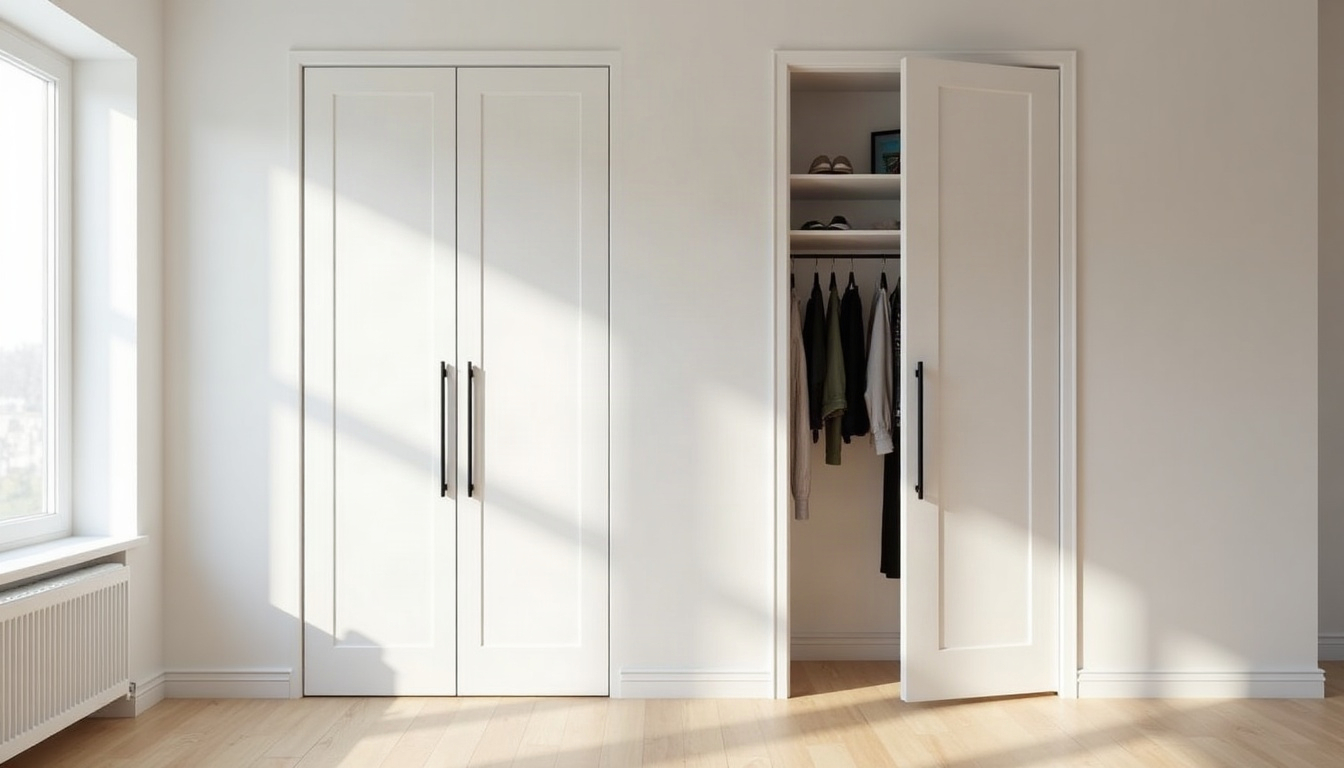
The best closet door for a bedroom depends on how much floor space sits in front of the closet. Hinged and French doors look the most finished but need room to swing. Bifold and bypass sliding doors take up very little of the room. Barn and pocket doors take up none, but a barn door needs bare wall beside the opening and a pocket door needs a hollow wall. If money or drilling is the problem, a curtain on a tension rod or a makeover of the doors you already have can change the look in an afternoon.
Below are 15 closet door styles, from classic French doors to closet door alternatives that skip the door completely. Each one comes with what it is good at, what it costs you in space and who it suits. A comparison table and a short guide to measuring your opening follow the list.
In this guide
Quick comparison
Clearance is the floor space in front of the closet that the door needs when it opens. Access is how much of the opening you can reach at once. Cost is relative: $ is a weekend project, $$$ usually means a carpenter.
To see what that means in inches, take a 48-inch opening. A pair of French doors has two 24-inch leaves, so you need about 24 inches of clear floor in front of the closet. A 48-inch bifold is usually four 12-inch panels that fold into two stacks, and each stack sticks out roughly 12 inches into the room. Bypass doors need nothing in front, but each panel covers about half the opening, so you reach roughly 24 inches of closet at a time, a little less once you allow for the overlap.
| Style | Clearance in the room | Access to the opening | Install | Cost |
|---|---|---|---|---|
| 1. Single hinged door | Full door width (swing arc) | Full | Pre-hung or existing frame | $$ |
| 2. French doors | One door width per leaf | Full | Pre-hung pair | $$ to $$$ |
| 3. Glass or frosted French doors | One door width per leaf | Full | Pre-hung pair | $$$ |
| 4. Bifold doors | About one panel width | Most of it | Track kit, DIY | $ to $$ |
| 5. Louvered doors | Depends on type (bifold or hinged) | Depends on type | DIY | $$ |
| 6. Accordion doors | A few inches | Most of it | Header track, DIY | $ |
| 7. Bypass sliding doors | None | About half at a time | Track kit, DIY | $ to $$ |
| 8. Mirrored sliding doors | None | About half at a time | Track kit, heavy panels | $$ |
| 9. Barn door | None, but needs bare wall beside the opening | Full | Wall-mounted rail, needs solid backing | $$ |
| 10. Pocket doors | None | Full | Opens the wall, usually a pro job | $$$ |
| 11. Translucent shoji-style panels | None | About half at a time | Track kit, DIY | $$ |
| 12. Curtains | None | Full | Tension rod or ceiling track | $ |
| 13. Hidden bookcase door | Full door width | Full | Pro or advanced DIY | $$$ |
| 14. Makeover of existing doors | No change | No change | Paint, trim, new pulls | $ |
| 15. No door at all | None | Full | Remove the door and hardware | $ |
Swinging doors
1. Single hinged door: the default for narrow closets
Narrow reach-in closets, up to about 36 inches wide, often have a single hinged door. It seals the closet completely, takes standard knobs and locks, and lets you use the back of the door for an over-the-door organizer or a full-length mirror. The cost is swing space. The door sweeps an arc as wide as itself, so anything in that zone (a bed corner, a dresser, a nightstand) gets in the way.
Best for: narrow closets where nothing sits in front of the door. Skip it if: the bed is closer to the closet than the door is wide.
2. French doors: a full view of the closet
Closet French doors are a pair of hinged doors that meet in the middle. Because each door is only half the opening, each one needs only half the swing space of a single door the same total width. Open both and you see the entire closet at once, which none of the sliding styles allow. That makes French doors a good fit for wider reach-ins (roughly 48 to 72 inches) in bedrooms with a clear path in front of the closet.
Most pairs close with a ball catch or a roller catch at the top, so you only need a dummy knob or pull on each side instead of a working latch.
Best for: primary bedrooms and wide closets you open every day. Skip it if: a dresser or bed sits within the swing of either leaf.
3. Glass or frosted French doors: borrowed light
Swapping solid panels for glass turns a dark wall into something lighter. Clear glass works if the closet is always tidy (and lit). Frosted, reeded or fluted glass gives you the light without showing every hanger. These are heavier and pricier than hollow-core doors, and the glass needs to be tempered, so they usually come as pre-hung units from a door retailer. Add a motion sensor closet light and a frosted door glows softly when you open the closet.
Best for: rooms that need more light, styled walk-in entrances. Skip it if: small kids play near the closet, or you’d rather hide the contents.

Folding doors
4. Bifold doors: the space-saving standard
Bifold doors are hinged panels that fold in half and stack at the sides of the opening. They’re one of the most common closet doors in American homes because they are cheap, easy to replace with a track kit, and they need only about one panel’s width of space in front of the closet when open. The trade-off is that the folded panels sit inside the opening, so you lose a few inches at each side. Over time the top pivots and guides can loosen, which is why many people buy a bifold door hardware kit (pivots, guides and track) rather than a whole new door.
Best for: standard reach-ins and tight bedrooms. Upgrade tip: new knobs or slim pulls make builder-grade bifolds look far less plain.
5. Louvered doors: for airflow
Louvered doors have angled slats that let air move through the closet. They come as bifolds or hinged doors and suit closets that tend to smell musty, laundry closets and humid climates. Unfinished pine louvers can be painted to match your trim. The slats collect dust, though, and they let a little light and sound through. If the closet still feels damp, see our closet accessories guide for moisture absorbers and cedar.
Best for: humid rooms, laundry closets, cottage and coastal styles.
6. Accordion doors: the cheapest way to cover a wide opening
Accordion doors are vinyl or fabric-covered panels that fold into a tight stack on one or both sides. They hang from a single header track, so installation is simple, and they cost less than most other doors for wide openings. They look basic and rattle more than solid doors, so they work best in kids’ rooms, basements, rentals and utility closets rather than as a design statement.
Best for: wide openings on a tight budget.
Sliding doors
7. Bypass sliding doors: zero swing space
Bypass doors are two (sometimes three) panels that hang from a double track at the top and slide past each other. They take no floor space in the room, which is why you’ll find them in most apartments and small bedrooms. With two panels, you can only open about half the closet at a time. Plan the inside so each side holds a complete “zone” (for example, hanging clothes on the left, shelves and shoes on the right), and see our best reach-in closet systems for layouts that work behind sliding doors. Torn between this and a bifold? Our sliding vs bifold closet doors comparison goes through space, access and cost side by side.
Doors that jump the track or drag usually need new rollers or a new bottom guide rather than new panels. Replacement sliding door hardware kits are inexpensive and sold by opening width.
Best for: small bedrooms, wide reach-ins, furniture close to the closet.
8. Mirrored sliding doors: a mirror and a door in one
Mirrored bypass doors add a full-length mirror without using any wall, and they bounce light around a small room. They are heavy, so check that the track and rollers are rated for mirrored panels. Older mirrored doors can look dated; some people frame them with thin trim or replace the frames rather than the whole unit.
Best for: small bedrooms with no room for a standing mirror.
9. Barn door: a sliding door that sits on the wall
A barn door hangs from a rail mounted on the wall above the opening and slides along the wall beside it. It opens the full closet, needs no floor space in front, and gives a room an instant focal point. Before you fall for the look, check two things:
- Bare wall beside the opening at least as wide as the door. Light switches, outlets and windows in that zone are a problem.
- Solid mounting. The rail must go into studs or a header board, because a solid door is heavy.
Most barn door hardware kits include the rail, rollers, end stops and a floor guide; check the weight rating against your door. The door should be a few inches wider than the opening so it overlaps the trim on both sides. A barn door doesn’t seal tightly, so light and sound get through the gaps. Wide openings can take two doors that part in the middle. Our barn door closet guide has the exact sizing, rail lengths and ways to close the privacy gaps.
Best for: rooms with a clear wall next to the closet, farmhouse and modern styles.
10. Pocket doors: the door disappears into the wall
A pocket door slides into a cavity inside the wall, so when it’s open you see nothing but the opening. It’s the cleanest-looking option and saves the most space, but retrofitting one means opening the wall, and the wall can’t have pipes, ducts or wiring in the way. It’s a sensible choice during a remodel and a hard one otherwise. Handles are flush pulls set into the door face.
Best for: remodels and new builds, tight hallways and small bedrooms.
11. Translucent shoji-style panels: soft light, light weight
Panels with a wood frame and a translucent insert (rice paper, polycarbonate or frosted acrylic) slide on a regular bypass track. They let light through, look calm and weigh very little. Genuine paper panels can tear, so look for acrylic or laminated inserts in kids’ rooms.
Best for: minimalist, Japandi and Scandinavian bedrooms.
Closet door hardware and kits
As an Amazon Associate I earn from qualifying purchases.
Closet door alternatives
Not every closet needs a door. These closet door alternatives cost less, suit rentals, or simply look better in some rooms.
12. Curtains: the easiest swap
A curtain can replace a broken bifold in an hour. For no drilling, use a tension rod inside the opening (best for openings up to the rod’s rated length). For a more finished look, mount a ceiling track or a rod above the opening and let the curtain hang from ceiling to floor, which makes the wall look taller. Choose a curtain wider than the opening, about one and a half to two times its width, so it hangs in folds instead of stretching flat. Ready-made closet curtains, or regular blackout or lined panels, hide the contents better than sheers. Our guide to closet door curtains has sizing numbers for common openings and the pros and cons of each way to hang them.
Best for: rentals, kids’ rooms, broken doors and tight budgets.
13. Hidden bookcase door: storage on the outside too
A bookcase door (sometimes sold as a “Murphy door”) is a hinged shelving unit that swings open like a door. Closed, it looks like built-in shelves. It’s one of the pricier options here. It swings like a regular door and is heavy, so it needs proper hinges and a solid frame. It makes most sense for a walk-in closet entrance or a home office closet.
Best for: walk-in closets and rooms where you want the closet to vanish.
14. Makeover of your existing doors
Flat builder-grade doors can look completely different without replacing them:
- Add trim to create a Shaker or picture-frame panel, then paint.
- Paint the doors a darker color than the walls (or match the walls for doors that blend in).
- Peel-and-stick wallpaper on flat panels. It’s removable, which helps renters.
- New pulls. Long bar pulls in matte black or brass are a cheap way to make bifold or sliding doors look newer.
Best for: anyone whose doors work fine but look tired.
15. No door at all: an open closet
Taking the door off turns a reach-in into an open nook. It gives you full access, removes the swing problem completely and can make a small room feel bigger. It only works if the inside looks good, so plan on matching hangers, bins on the shelf and a clear floor. Our small bedroom closet ideas cover how to set up the inside so it can stay on display. Keep the door and hardware in storage if you rent.
Best for: kids’ rooms, small studios, tidy people.
No-door and makeover options
As an Amazon Associate I earn from qualifying purchases.
Which closet door fits your room?
- Small bedroom with the bed or a dresser near the closet: bypass sliding doors, a barn door if the wall beside it is free, or a curtain.
- Wide closet in a primary bedroom: French doors if the floor in front is clear, otherwise bypass doors with a good interior layout.
- Rental: curtains on a tension rod, new pulls (keep the old ones), or peel-and-stick on the existing doors.
- Kids’ room: curtains, an open closet or lightweight bifolds. Avoid heavy glass and mirrors.
- Remodel: pocket doors are worth considering while the walls are open.
- Humid or musty closet: louvered doors.
Measure before you buy
Closet doors are sold by the rough opening, and a mistake of half an inch is enough to make a door bind. Measure:
- Width at the top, middle and bottom of the opening. Use the smallest number.
- Height at the left, center and right. Many closet doors are made for an 80-inch opening, but older homes vary.
- Depth of the jamb and any trim that a track needs to sit on.
- Swing or slide space: the clear floor in front of the closet, and for a barn door, the clear wall beside it.
- Flooring: carpet, tile and wood each take different bottom guides, and new flooring can raise the floor enough to matter.
Swapping out an old door yourself? Our step-by-step guide on how to replace closet doors covers removal, sizing between stock widths, installation for each door type and typical costs.
Our guide to reach-in closet dimensions lists the standard opening widths and depths, and you can sketch your wall with the free closet design tool to see how a door style affects the space inside. If the closet is long and narrow, check our long narrow closet ideas first: in those, a full-width sliding or French door often matters more than the door style.
FAQ
What is the cheapest closet door option?
A curtain on a tension rod is usually the cheapest, followed by accordion doors and basic bifolds. Check current prices on Amazon or at a home store, since they vary by size and material.
Are French doors good for closets?
Yes, if you have the floor space. They show the whole closet at once and look more finished than sliding doors. Each leaf needs a clear swing zone about as deep as the leaf is wide, so they’re a poor fit when the bed sits close to the closet.
Sliding or bifold closet doors: which is better?
Bifolds give you access to more of the opening at once but need a little floor space. Bypass sliding doors need no floor space but only open about half the closet at a time. Choose sliders when furniture sits close to the closet, bifolds when you want to see more at once.
Can I put a barn door on a closet?
Yes, as long as the wall beside the opening is at least as wide as the door and free of switches and outlets, and the rail can be anchored into studs or a header board. Expect small gaps around the edges.
What can I use instead of a closet door?
Curtains, a ceiling track with fabric panels, a hidden bookcase door, or no door at all. Curtains are the easiest and work well in rentals.
How do I update closet doors without replacing them?
Add trim to make Shaker-style panels, paint them, apply peel-and-stick wallpaper or swap the knobs for longer pulls. On bifold and sliding doors, new hardware often fixes sticking too.
The bottom line
Decide on the space in front of the closet first, then pick a style. If there’s room to swing, French doors give the best view of the closet. If there isn’t, bypass sliders, a barn door or a curtain take nothing from the room. And if your doors work but look dull, paint, trim and new pulls cost far less than new doors.
Product details and prices change. Always check the current listing before you buy.
Shop the look on Amazon