Disclosure: ClosetBlueprint is reader-supported. When you buy through links on our site, we may earn an affiliate commission at no extra cost to you. Learn more.
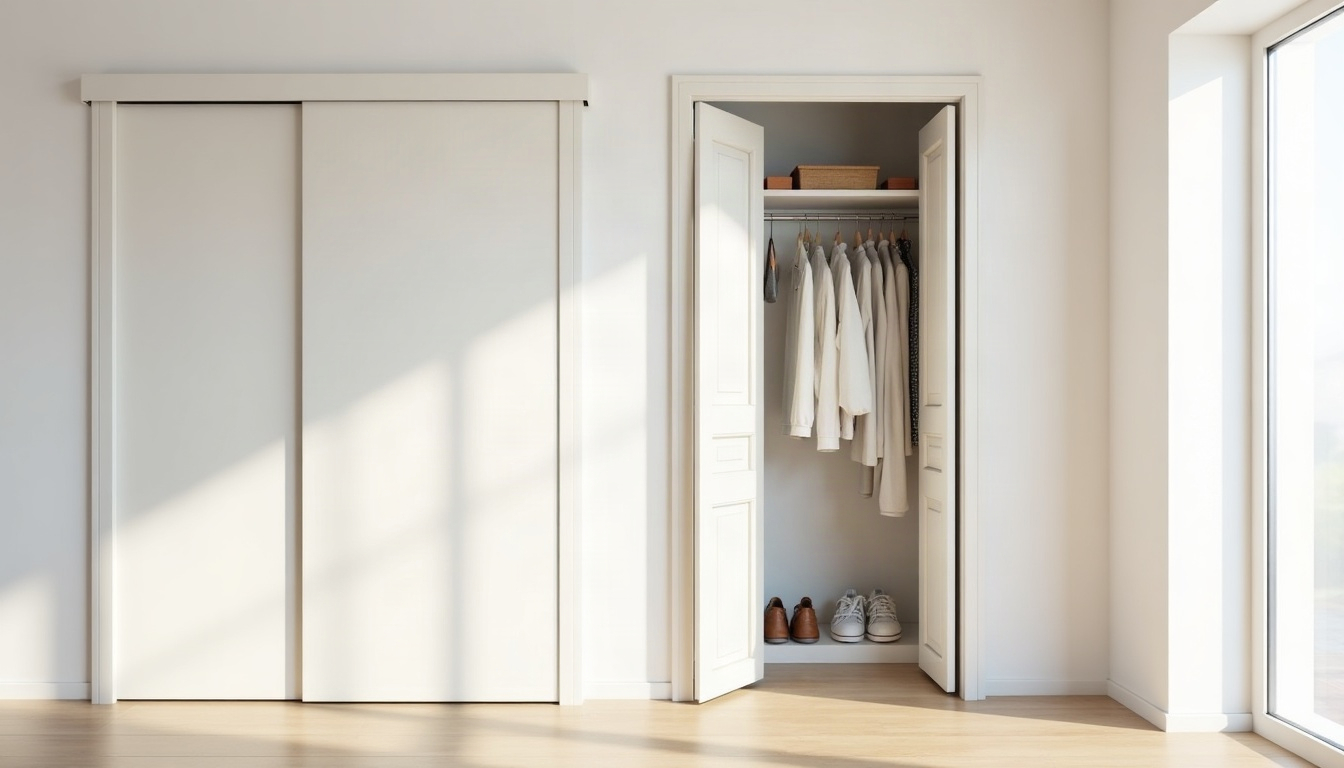
Pick sliding closet doors if the floor in front of the closet is tight or a bed sits close to it, and you can live with reaching one half of the closet at a time. Pick bifold closet doors if you want to see almost the whole closet at once and you can spare about a foot of floor in front of each folded stack. On price the two are close: basic hollow-core versions of both are among the cheapest closet doors you can buy, and mirrors, glass or solid wood raise the cost of either one.
The rest of this guide compares them on the things that decide it in a real room: how much floor each one needs, how much of the closet you can reach, what installation involves, what tends to break and what it all costs. If you are still deciding between these two and other styles such as barn, pocket or French doors, start with our 15 closet door ideas.
In this guide
Quick comparison
“Bypass sliding” means the usual bedroom closet slider: two or more panels hanging from a double track at the top, gliding past each other. Barn and pocket doors also slide, but they work differently and are covered in the door ideas guide linked above.
| Bypass sliding doors | Bifold doors | |
|---|---|---|
| Floor space needed in front | None | About one panel width per folded stack (roughly 12 in. on a 48 in. four-panel door) |
| Closet you can reach at once | About half the opening | Most of the opening (folded panels stay inside the frame) |
| Common widths | 48 to 96 in., wider with three or more panels | 24 to 36 in. (two panels), 48 to 72 in. (four panels) |
| Hardware | Top track, rollers, floor guide | Top track, pivots, guide wheel, aligners |
| DIY difficulty | Easy to moderate | Moderate (more adjustment) |
| Typical complaint | Doors jump the track or drag on the floor guide | Panels sag, pivots wear, doors come off the track |
| Mirror option | Common, and the mirror is always visible | Available, but less common |
| Relative cost | $ (basic) to $$$ (mirror, glass, wood) | $ (basic) to $$$ (louvered wood, glass) |
Space: how much room each door takes
This is the main reason people choose one over the other, so it is worth doing the math for your own closet.
Sliding doors need no floor space in the room. The panels stay in the plane of the opening, so a dresser, a desk chair or the side of a bed can sit right up to the closet. That is why builders put bypass doors in so many small bedrooms.
Bifold doors fold out into the room. Each pair of panels folds in half and the stack sticks out roughly one panel width. On a 48-inch four-panel bifold, each panel is about 12 inches wide, so you need about 12 inches of clear floor in front of each side. On a 30-inch two-panel bifold the single stack is about 15 inches. That is far less than a hinged door, which needs its full width as a swing arc, but it is not zero. A nightstand or the corner of a bed 10 inches from the frame will stop a bifold from opening all the way.
Quick check: open a tape measure from the closet frame straight into the room. If you have at least half the width of one door pair of free floor, a bifold will open fully. If not, slide.

Access: how much of the closet you can reach
Here the result flips.
Sliding doors only ever open half the closet. With two panels on a 72-inch opening, each panel is a little over 36 inches wide (they overlap so there is no gap when closed). Whichever side you open, the other panel is parked in front of the other half. You can reach roughly 34 to 36 inches at a time. That matters if the closet has a dresser or drawer unit in the middle, or long shelves you want to see in one look. A drawer unit placed behind the overlap can end up half blocked from both sides. Three-panel sliders on wide openings let you open about a third or two-thirds, depending on how you stack them.
Bifolds open almost all of it. When open, the folded stacks sit inside the frame at each side, so they block a few inches at each end (the thickness of two panels plus hardware). You see the whole hanging rod and every shelf at once. For a closet with a built-in system, a center tower or drawers, that is a big advantage. Plan the layout so nothing you use every day sits in the last few inches at each end.
If you are laying out shelves, rods and drawers behind new doors, our free closet design tool lets you draw the closet to your measurements, and the reach-in closet dimensions guide covers depth and rod heights.
Installation: what each one involves
Both are realistic DIY projects for someone comfortable with a drill, a level and a helper. Neither needs a new frame if the opening is square and the old door came out cleanly.
Installing bypass sliding doors
- Screw the double track to the header, level along its whole length.
- Fit the rollers to the top of each panel, hang the back panel on the rear channel first, then the front panel.
- Set the floor guide at the center so both panels stay in line at the bottom.
- Adjust the rollers until the panels hang plumb and the gap at the floor is even.
Installing bifold doors
- Screw the single track to the header.
- Set the bottom pivot bracket on the floor (or on the side jamb) directly below the top pivot.
- Seat the top pivot and the guide wheel in the track, drop the bottom pivot into its bracket.
- Adjust height and side-to-side position, then add aligners on four-panel doors so the two pairs meet flat in the middle.
Bifolds need more fiddling. The panels have to be adjusted so they don’t rub the jamb, and on four-panel doors the two halves must line up in the center. Sliders are more forgiving: if the track is level, they usually hang well with little adjustment.
Both styles come in standard heights (80 inches is the most common in US homes) and standard widths. Measure the finished opening width at the top, middle and bottom, and the height on both sides, then compare with the manufacturer’s sizing chart. Most kits list the opening each door fits. If your closet is an unusual width, sliders are easier to fit: you can choose panel widths with more overlap. A bifold that is too narrow for the opening leaves a gap, and cutting one down is limited to a small amount on each side.
Durability and common problems
Most complaints about both styles come from cheap hardware, not from the doors themselves.
Sliding door problems: plastic rollers wear and flatten, and a panel can lift out of the track if someone pushes it from the bottom. The floor guide gets kicked loose or scrapes the bottom of the doors. Heavy mirror panels put the most load on rollers. Fixes are simple: ball-bearing rollers, a metal track and a floor guide screwed down firmly.
Bifold door problems: the guide wheel pops out of the track, the bottom pivot bracket loosens, and hinges between panels sag on hollow-core doors. Kids pulling a bifold from the middle make it worse. A metal track, a sturdy pivot set and replacing worn hinges fix most of it.
In practice, both last for years if the hardware is decent and the track stays level. If your current doors keep coming off the track, replacing the hardware is often enough. You may not need new panels.
Closet door hardware
As an Amazon Associate I earn from qualifying purchases.
Cost: what changes the price
Prices vary a lot by size, material and region, so check current prices at your home improvement store or on Amazon. What we can say is how the two compare and what pushes the cost up.
- Basic panels cost about the same. Hollow-core primed bifolds and basic bypass panels in standard sizes are both at the low end of what closet doors cost.
- Width affects sliders more. A wide bypass set is two or three large panels plus a long double track. A wide bifold is four smaller panels. On very wide openings, sliders can cost more.
- Mirrors and glass add the most. Mirrored bypass doors are a popular upgrade and cost noticeably more than plain panels. Louvered and glass-paneled bifolds also cost more than flat ones.
- Solid wood and custom sizes are at the top. Either style in solid wood or made to measure moves into carpenter-project prices.
- Labor: both are often DIY. If you hire it out, bifolds usually take a little longer to hang and adjust.
If you are only replacing worn hardware, a new track kit for either style costs far less than new doors.
Which one should you pick?
Choose sliding doors if: the bedroom is small, furniture sits close to the closet, the closet is wide (72 inches or more), you want a full-length mirror built into the door, or the closet mainly holds hanging clothes you can reach half at a time.
Choose bifold doors if: you want to see and reach the whole closet at once, the closet has a center drawer unit or a built-in system, the opening is 36 inches or less (a sliding door makes little sense there), or the closet is in a hallway, laundry nook or pantry where you need full access.
Some rooms point to neither. If you have bare wall beside the closet, a barn door opens the whole closet with no floor space needed in front. If you just want to hide the clothes on a budget, a curtain on a tension rod does it. Both are covered in our closet door ideas, and if the real problem is a cramped closet, see small bedroom closet ideas.
Sliding closet doors for bedrooms: a few tips
- Put the most-used clothes on the side you open most often. With bypass doors, one side tends to stay open. Store everyday clothes there and off-season items behind the other panel.
- Keep drawers away from the overlap. A drawer unit centered behind the meeting point of two panels can only be opened halfway from either side. Put it to one side.
- Consider mirrored panels in small rooms. A mirror on the door saves wall space for a separate full-length mirror and makes the room look larger.
- Use soft-close or ball-bearing rollers if the closet is next to where someone sleeps. They are noticeably quieter than basic nylon wheels.
FAQ
Are sliding or bifold closet doors better?
Neither is better in general. Sliding doors are better when floor space in front of the closet is tight. Bifold doors are better when you want access to the whole closet at once. Measure the free floor in front of the closet and think about how you use the inside, then pick.
Can I replace bifold doors with sliding doors?
Usually yes, if the opening is wide enough. Remove the bifold track and pivot brackets, patch the screw holes, and install a bypass track kit sized for the opening. Sliders work best on openings of about 48 inches and up; on narrow openings, each panel only uncovers a small part of the closet.
Do bifold doors take up a lot of space?
Less than a hinged door. When open, each folded stack sticks out about one panel width into the room, roughly 12 inches on a typical 48-inch four-panel bifold.
Why do sliding closet doors come off the track?
Most often the rollers are worn or set too low, the track is not level, or the floor guide is loose or missing. Adjusting roller height, tightening or replacing the floor guide and leveling the track fixes most cases.
What size closet door do I need?
Measure the finished opening (width at top, middle and bottom; height at both sides) and use the smallest numbers. Then match them to the door maker’s sizing chart, which lists the opening each door or kit fits.
The bottom line
Sliding doors save floor space but open only half the closet. Bifold doors open nearly the whole closet but need about a foot of free floor in front of each stack. Base prices are similar, and finishes like mirrors, glass or wood matter more for cost than the style itself. Measure the floor in front of your closet, think about where your drawers and shelves sit inside, and the choice usually makes itself.
Shop the look on Amazon