Disclosure: ClosetBlueprint is reader-supported. When you buy through links on our site, we may earn an affiliate commission at no extra cost to you. Learn more.
The best jewelry organizer for a closet depends on where you have free space. If the rod has a few spare inches, a clear hanging organizer with zip pockets and necklace loops is the cheapest fix. If you have a drawer, stackable velvet trays keep rings and earrings sorted and out of sight. If you have a bare wall or the back of a door, a mirrored jewelry cabinet holds the most and doubles as a full-length mirror. Most people with a big collection end up combining two: trays for small pieces and a hanging or wall option for necklaces.
This guide compares six types of jewelry organizer by where they go, what they hold best, how much space they take and how hard they are to install. Sizes and capacities are typical of manufacturer listings, not our own measurements, so check the listing of the exact product before you buy.
In this guide
- Quick comparison
- Start with where it will live
- 1. Hanging rod organizer
- 2. Stackable drawer trays
- 3. Mirrored jewelry cabinet
- 4. Wall necklace bar or hooks
- 5. Jewelry box
- 6. Closet drawer insert
- Which one should you buy?
- What to check on the listing
- Tips to keep jewelry from tangling and tarnishing
- FAQ
- The bottom line
Quick comparison
| Type | Where it goes | Best for | Space it uses | Install | Budget level |
|---|---|---|---|---|---|
| Hanging rod organizer | Closet rod | Earrings, bracelets, everyday necklaces | About 2 to 4 inches of rod | None, hangs on a hook | $ |
| Stackable drawer trays | Dresser or closet drawer | Rings, studs, watches, a mixed collection | One drawer, about 2 to 4 inches deep | None | $–$$ |
| Mirrored jewelry cabinet | Wall or back of a door | Large collections, necklaces at full length | About 14 to 16 inches of wall, 4 to 5 inches deep | Over-door hooks or wall screws | $$–$$$ |
| Wall necklace bar or hooks | Side wall or end panel | Long necklaces and chains that tangle | 12 to 24 inches of wall, almost no depth | Adhesive or 2 small screws | $ |
| Jewelry box | Shelf, dresser top or island | Fine pieces, travel, gifts | A shelf spot about 10 by 7 inches | None | $–$$$ |
| Closet drawer insert | Closet system drawer or island | Built-in closets and walk-ins | Fits inside an existing drawer | Cut or order to size | $$–$$$ |
Start with where it will live
Jewelry organizers fail when they are bought first and placed second. Before you choose a style, find the spot:
- Rod space. If you can free 3 or 4 inches on the rod, a hanging organizer costs little and needs no tools. It works best in a reach-in closet you open every day.
- A drawer. A shallow top drawer in a dresser or closet system is the best place for small pieces. Measure the inside width, depth and height, because trays are sold in fixed sizes.
- A door or wall. The back of the closet door or a side wall is usually unused. A mirrored cabinet or a necklace bar turns it into storage without taking any rod or shelf space.
- A shelf or island top. A jewelry box is fine here, as long as you can see into it without a step stool.
If you are planning a new closet layout anyway, mark a drawer or a wall panel for jewelry in our free closet design tool so it has a place from the start.

1. Hanging rod organizer
A hanging jewelry organizer is a long panel of clear vinyl pockets on a swivel hanger, often with hook-and-loop tabs or small hooks for necklaces. You hang it on the rod like a shirt. Clear pockets let you see every pair of earrings at a glance, and both sides are usually usable.
The weak points are the pockets themselves. Studs and small rings slide to the bottom corner, and heavy pieces stretch thin vinyl over time. Look for a model with zip or snap pockets, a sturdy swivel hook and a bottom edge that is stitched, not just glued.
Best for: renters, small reach-in closets and anyone who wants the cheapest fix that takes five seconds to set up.
2. Stackable drawer trays
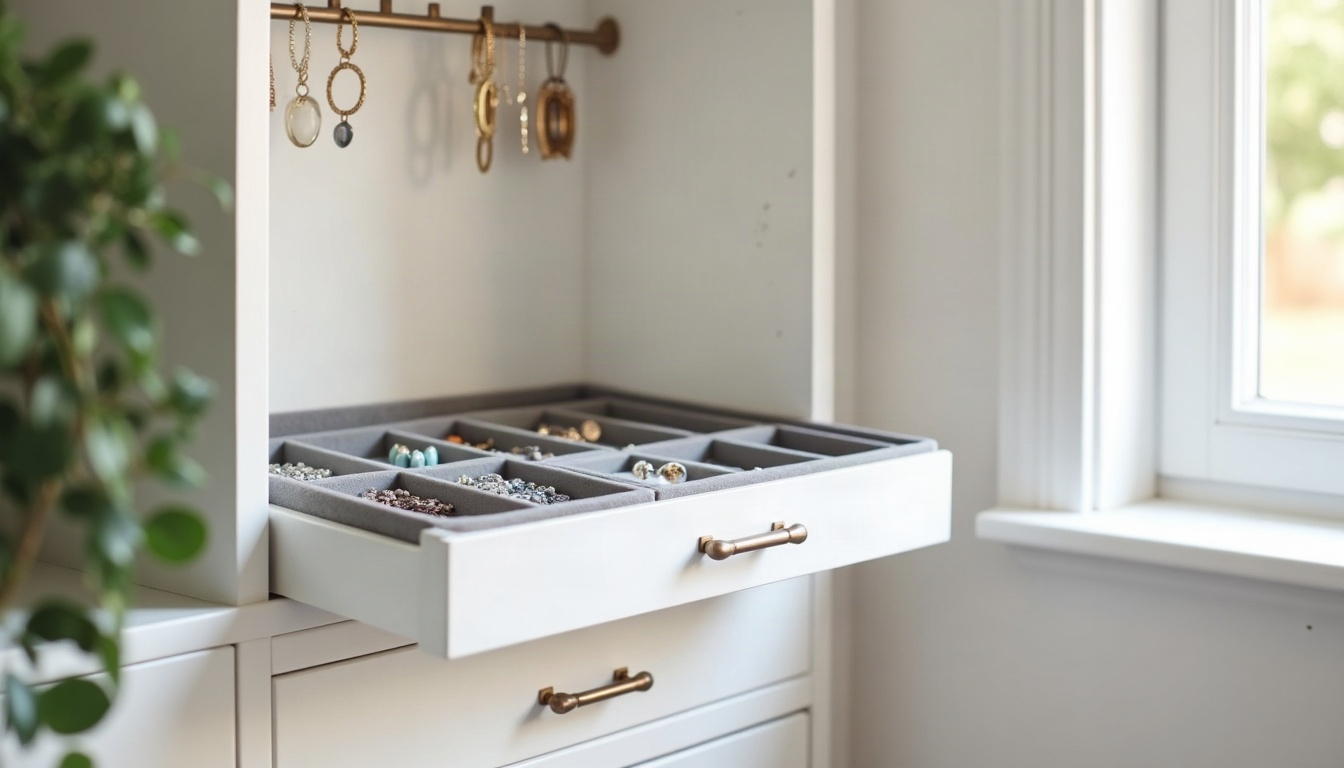
Velvet or felt-lined trays with ring rolls, small square compartments and longer sections for bracelets. Many are sold as sets of two or three that stack, so you lift the top tray to reach the one below. They keep pieces flat, separated and dust-free.
Check the inside height of your drawer before you buy a stack. Most trays are about 1 to 1.5 inches tall each, so a stack of three needs a drawer around 4 inches deep inside. Necklaces are the weak point: they need a long, narrow section or they will knot.
Best for: rings, stud earrings and watches, and anyone with a dresser inside or near the closet. See our ideas for fitting a dresser in a closet if you need a drawer to put them in.
3. Mirrored jewelry cabinet
A full-length mirror on the front, and behind it a shallow cabinet with necklace hooks, ring slots, earring holes and often a small drawer or two. Most mount on the wall with screws or hang over a door with hooks, and many have LED lights inside and a key lock. Typical listings are around 40 to 48 inches tall and 14 to 16 inches wide.
It holds the most jewelry for the floor space it uses, which is none. The trade-offs are weight and depth. A loaded cabinet is heavy, so wall mounting should go into studs or proper anchors, and over-door versions need a door with enough clearance to close. Check the depth, usually 4 to 5 inches, against the space between the door and the shelves behind it.
Best for: large collections, people who also need a full-length mirror, and walk-in closets with a free wall.
4. Wall necklace bar or hooks
A simple bar or row of hooks on the wall, so each necklace hangs on its own peg at full length. It is the most reliable way to stop chains from tangling, because nothing touches anything else. Some versions add a small shelf for perfume or a ring dish.
Put it at eye level on a side wall or the end panel of a closet system, where clothes will not brush against it. Long necklaces need about 20 inches of clear wall below the hook. Adhesive versions are fine for light chains; use screws for anything heavier.
Best for: long necklaces and layered chains, and closets with a small strip of free wall.
5. Jewelry box
A lidded box with a lift-out tray, ring rolls and a mirror in the lid. It is the most familiar option and the easiest to move or travel with. Leather, faux leather, wood and lacquer boxes all work; choose by how often you open it and how much it needs to hold.
A box is a poor fit for necklaces unless it has a tall side door with hooks, and it hides everything below the top tray. Keep it on a shelf at chest height, not on the top shelf, or you will stop using it.
Best for: fine jewelry and a small collection you want to keep closed and dust-free.
6. Closet drawer insert
If you have a closet system or an island with drawers, a fitted insert turns one drawer into a jewelry drawer. Some closet brands sell velvet inserts sized to their drawers; otherwise, modular trays or drawer dividers can be combined to fill the space. A shallow drawer of 3 to 4 inches is ideal; deeper drawers waste space unless you stack trays.
This is the neatest result, and the most expensive one if you order a custom insert. Measure the inside of the drawer, not the front, because sides and slides eat up an inch or more.
Best for: walk-in closets and built-ins. If you are planning a center island, see our guide to the walk-in closet with an island, where the top drawer is the natural home for jewelry.
Jewelry organizer picks
As an Amazon Associate I earn from qualifying purchases.
Which one should you buy?
- Small reach-in closet, small budget: a hanging rod organizer, plus a necklace bar on the inside wall if your chains tangle.
- You have a dresser or a closet drawer: stackable velvet trays for rings and earrings.
- Large collection or you need a mirror: a mirrored jewelry cabinet on the door or a free wall.
- Walk-in or built-in closet: a fitted drawer insert in the top drawer, with a wall bar for long necklaces.
- Mostly fine jewelry: a lined box with a lock, or a small closet safe for the pieces that matter most.
What to check on the listing
- Lining. Velvet, suede or felt protects metal and stones from scratches. Bare plastic or wood is fine for costume jewelry only.
- Necklace length. The hooks should leave enough drop for your longest chain. Many cabinets and hanging panels are short at the necklace section.
- Dimensions against your space. Drawer inside height, door clearance and wall width matter more than capacity claims.
- Mounting hardware. For a wall cabinet, check the weight and whether it includes anchors. Over-door hooks should fit your door thickness.
- Lock and lights. Useful in a shared home and a dark closet. If your closet has no light, a cabinet with LEDs or a motion sensor closet light makes small pieces much easier to find.
Tips to keep jewelry from tangling and tarnishing
- One necklace per hook. Two chains on the same hook will knot. Fasten the clasp before you hang it.
- Keep it dry. Silver tarnishes faster in humid air. Avoid the wall of a closet that backs onto a bathroom, and add a small moisture absorber or anti-tarnish strips in drawers.
- Sort by how often you wear it. Everyday pieces go in the most visible spot; occasional pieces go in a tray or box below.
- Keep watches separate. Watches scratch other pieces and need a pillow slot. A watch box or valet tray keeps them apart.
Jewelry organizers are one of the small fixes in our list of closet accessories most closets need.
FAQ
What is the best way to organize jewelry in a closet?
Store small pieces flat in lined drawer trays and hang necklaces at full length, either on a wall bar or inside a mirrored cabinet. If you have no drawer, a clear hanging organizer on the rod is the simplest option.
Are hanging jewelry organizers any good?
Yes, for earrings, bracelets and everyday necklaces. They are cheap, need no tools and let you see everything. They are less suited to fine jewelry, because the pockets are not lined and small pieces collect at the bottom.
Where should I store necklaces so they don’t tangle?
Hang each one on its own hook with the clasp closed, with enough drop below the hook that the chain does not pile up. A wall necklace bar or the necklace section of a mirrored cabinet works best.
How deep should a jewelry drawer be?
About 2 to 4 inches inside is ideal. A shallow drawer keeps everything visible. In a deeper drawer, use stackable trays so the space is not wasted.
Is it safe to mount a jewelry armoire on a door?
Usually, if the hooks fit your door thickness and the door has room to close. Check the cabinet’s weight against the listing’s door limits, and use wall mounting into studs for heavy, fully loaded cabinets.
How do I keep silver jewelry from tarnishing in a closet?
Keep it dry and covered. Use lined trays or a closed box, add anti-tarnish strips or a moisture absorber, and avoid closets that share a wall with a shower.
The bottom line
Pick the organizer by the space you have, not by the photo. A hanging rod organizer is the cheapest start for a small closet. Stackable velvet trays are the best choice if you have a drawer. A mirrored jewelry cabinet holds the most and uses no floor space, as long as the door or wall can take its weight. For long necklaces, add a simple wall bar so every chain hangs on its own hook.
Shop the look on Amazon