Disclosure: ClosetBlueprint is reader-supported. When you buy through links on our site, we may earn an affiliate commission at no extra cost to you. Learn more.
The best pants hangers for most closets are open-ended slack hangers with a non-slip bar. You slide the pants on from the side in one move, they take no more rod space than a slim shirt hanger, and the grip keeps dress pants from sliding off. Clip hangers are the better choice if you want zero fold line, because the pants hang straight from the hem or waistband. Multi-bar and vertical hangers save the most rod space, and a pull-out pants rack is the best option if you own a closet system with a free section and a lot of trousers.
This guide compares six ways to hang pants: how each one holds the fabric, how much rod space it uses, how easy it is to get a pair on and off, and which pants suit it. Sizes and capacities come from typical manufacturer listings, not from our own measurements, so treat them as approximate and check the listing of the exact product you are buying.
In this guide
- Quick comparison
- Fold or hang straight?
- What to check on the listing
- 1. Open-ended slack hangers: best overall
- 2. Clip hangers: best for zero fold lines
- 3. Multi-bar swing-arm hangers: best for many pairs in one spot
- 4. Vertical multi-layer hangers: best for jeans in a tight closet
- 5. Wooden trouser hangers with locking bar: best for suits and good trousers
- 6. Pull-out pants rack: best for closet systems
- Which pants hanger for which pants
- How much space do pants need?
- Tips for hanging pants
- FAQ
- The bottom line
Quick comparison
| Type | Best for | Rod space per pair | Fold line | Install | Budget level |
|---|---|---|---|---|---|
| Open-ended slack hangers | Dress pants, chinos, daily use | About 1/4 to 1/2 inch (one slim hanger) | Soft fold over the bar | None | $ |
| Clip hangers | Wool trousers, linen, pleated pants, skirts | About 1/2 inch | None | None | $ |
| Multi-bar swing-arm hangers | Many pairs in one spot | One hanger holds about 4 to 6 pairs | Soft fold | None | $–$$ |
| Vertical multi-layer hangers | Jeans and casual pants in a tight closet | One hook holds about 4 to 6 pairs, stacked down | Soft fold | None | $ |
| Wooden trouser hangers with locking bar | Suits and expensive trousers | About 1/2 inch or more | Soft fold, padded or felted bar | None | $$ |
| Pull-out pants rack | Closet systems, large trouser collections | Uses cabinet width, not rod space | Soft fold | Screws into a panel or shelf | $$–$$$ |
Fold or hang straight?
There are two ways to hang pants, and the choice decides which hanger you need.
- Folded over a bar. The pants are folded in half at the knee and laid over a bar. It is fast, works with almost any hanger and takes very little height, about 22 to 26 inches for adult pants. The downside is a soft fold line at the knee, which matters on linen and thin wool but rarely on jeans or chinos.
- Hung full length from clips. The pants hang upside down from the hem, or right side up from the waistband. Gravity pulls light creases out and there is no fold line. It needs more height, roughly 40 to 46 inches for most adult pants, so it belongs in a long or medium hanging section, not under a double rod.
If you are not sure how tall your hanging sections are, our closet rod height guide lists the usual heights for double, medium and long hanging. Folded pants fit comfortably on the lower rod of a double-hang section, which is where most people should keep them.

What to check on the listing
- Bar grip. Rubber, foam, flocked or textured bars stop slippery dress pants from sliding off. A plain smooth bar is fine for jeans and not much else.
- Open end or closed bar. Open-ended hangers let you slide pants on from the side without lifting the hanger off the rod. Closed bars need you to thread the leg through.
- Clip padding. Clips should have rubber or felt pads, or they can leave marks on wool and silk. Check that the clips slide along the bar so you can match the width of the waistband.
- Hook. A swivel hook makes it easier to turn hangers to face the same way. On multi-bar hangers, check that the hook is solid metal, since it carries the weight of several pairs.
- Weight rating. For multi-bar hangers and pull-out racks, look for the maker’s weight or pair capacity. Six pairs of jeans weigh a lot more than six pairs of dress pants.
- Width. Most pants hangers are about 14 to 17 inches wide. Narrow ones are fine for pants but will not double as shirt hangers.
1. Open-ended slack hangers: best overall
An open-ended slack hanger is a single bar with the hook at one end and the other end left open, so you slide pants on from the side. Most are slim metal coated in rubber or vinyl, or slim wood with a non-slip strip. They take up about as much rod space as a slim shirt hanger, which makes them the easiest way to fit more pants on a crowded rod.
Pros
- One-handed: slide pants on and off without taking the hanger off the rod
- Slim, so the rod holds a lot of pairs
- Non-slip coating keeps dress pants in place
Cons
- Leaves a soft fold line at the knee
- Cheap coatings can peel or get sticky over time
Best for: office trousers, chinos and anyone who wants pants that are quick to grab and put away.
2. Clip hangers: best for zero fold lines
Clip hangers have two or more clips on a bar. You hang pants full length from the hem or the waistband, so there is no fold. They also handle skirts and shorts, which makes them useful as a general bottoms hanger. Look for padded clips that slide along the bar.
Pros
- No fold line, and light creases drop out
- Works for pants, skirts and shorts
- Slim, especially the metal or plastic versions
Cons
- Needs about 40 inches of hanging height or more
- Slower to use: two clips per pair
- Unpadded clips can mark delicate fabric
Best for: wool and linen trousers, pleated pants, skirts and anything you hate to iron.
3. Multi-bar swing-arm hangers: best for many pairs in one spot
These hangers stack several bars on one frame, usually around 4 to 6. On swing-arm versions each bar pivots out from one side, so you can take one pair without lifting the rest. One hanger holds what would otherwise take several inches of rod.
Pros
- Big space saving on a full rod
- Swing arms let you reach one pair without disturbing others
- No installation
Cons
- Heavy once loaded, so it puts more weight on one point of the rod
- Pairs on the inner bars are harder to see
- Thick fabrics like denim fill it fast
Best for: dress pants and chinos in a small closet, and pants you rotate through every week.
4. Vertical multi-layer hangers: best for jeans in a tight closet
Vertical pants hangers, often sold as “magic” or S-shaped pants hangers, are a tall frame with several open-ended bars stacked one below the other. You see one pair per layer from the front, and the whole stack hangs from one hook. They are a pants-specific version of the cascading hangers people use for tops.
Pros
- Uses height instead of rod width
- Open ends make each pair easy to pull out
- Usually inexpensive, often sold in packs
Cons
- Needs a tall section: a full stack can hang 30 inches or more
- Lighter frames bend under several pairs of heavy jeans
Best for: jeans and casual pants in reach-in closets where the rod is full but there is height under it.
5. Wooden trouser hangers with locking bar: best for suits and good trousers
These are solid wood hangers with a felted or padded bar that locks shut, or a clamp that holds the pants between two wooden bars. The locking bar keeps trousers from slipping when you pull the hanger off the rod, and many have broad shoulders so the matching jacket can share the hanger. They are the same idea as the suit hangers in our guide to closet hangers, just built around the pants.
Pros
- Pants stay put, even when you carry the hanger
- Felted or padded bars are gentle on wool
- Keeps a suit together on one hanger
Cons
- Bulky: takes more rod space than any other pants hanger
- Costs more per hanger
Best for: suits, tailored trousers and the few pairs you want to protect.
6. Pull-out pants rack: best for closet systems
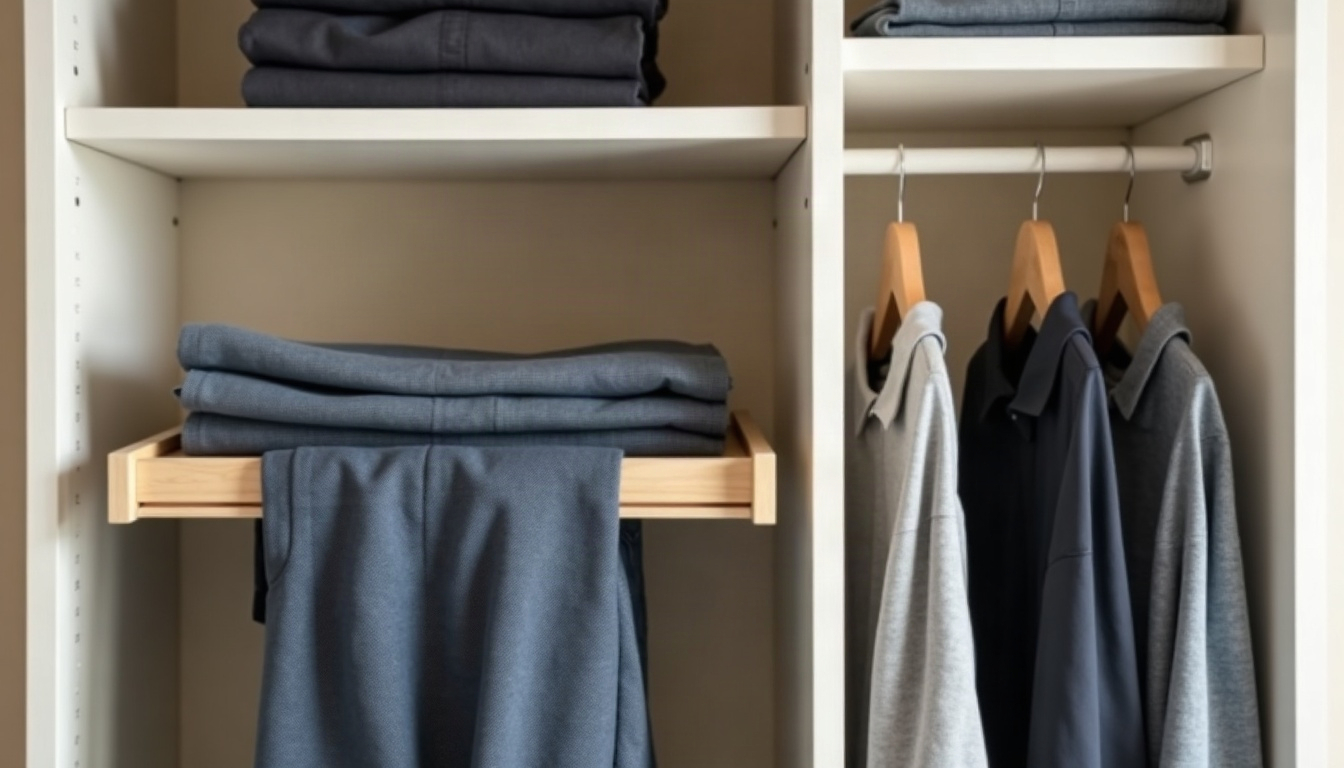
A pull-out pants rack is a frame of bars on a slide that mounts inside a closet section. You pull it out like a drawer and the pants hang over the bars side by side, so you see every pair at once. Most mount either under a shelf (top-mount) or to the side of a panel (side-mount). Typical racks hold somewhere around 8 to 20 pairs, depending on width and bar spacing, and come in widths that fit common closet sections, roughly 18 to 30 inches.
Pros
- Every pair visible at once, nothing hidden behind other clothes
- Frees the rod for shirts and jackets
- Pants stay flat and separated
Cons
- Needs screws, and usually a closet system or cabinet section to mount on
- You must match depth and width to your section before buying
- Costs more than a set of hangers
Best for: walk-in closets and built-in systems with a free section, and people who own 15 or more pairs of trousers.
Before you buy a pull-out rack, measure the inside width and depth of the section you plan to use. Our guide to measuring your closet shows where to measure, and the free closet design tool helps you plan which section gets the rack. Systems like the ones in our walk-in closet systems guide often sell their own pull-out pants racks that fit their panel widths.
Which pants hanger for which pants
| Pants | Best hanger | Why |
|---|---|---|
| Dress pants, chinos | Open-ended slack hanger | Fast and slim, grip holds smooth fabric |
| Wool and linen trousers | Padded clip hanger or felted locking bar | No fold line or a gentle one |
| Suit trousers | Wooden suit hanger with locking bar | Jacket and pants stay together |
| Jeans | Vertical multi-layer hanger, or fold on a shelf | Denim does not crease much and is heavy |
| Leggings, joggers | Drawer or shelf | Stretchy knits lose shape when hung for long |
| Skirts | Clip hanger | Hangs from the waistband with no fold |
How much space do pants need?
Folded over a slim hanger, a pair of dress pants takes roughly as much rod space as a dress shirt, so you can plan for something like 8 to 12 pairs per foot of rod. Jeans are bulkier, closer to 5 to 7 pairs per foot. These are rough planning figures, but they help you decide if hangers are enough or if you need a rack.
Here is a simple example. Someone with 24 pairs of work pants and 8 pairs of jeans needs about 2 to 3 feet of lower rod with slim hangers. Swap the dress pants onto multi-bar hangers and the same collection fits in about a foot and a half. Move the work pants to a pull-out rack and the rod is free for shirts. If the rod is the problem, a pull-out rack or a second rod in a small closet does more than new hangers.
Tips for hanging pants
- Hang them on the lower rod. Folded pants need only about 22 to 26 inches, so they fit perfectly under a top rod of shirts.
- Fold on the crease. Line up the legs on the front crease before folding over the bar, and the fold line sits where the pants already bend.
- Use one hanger type per section. Matching hangers keep pants at the same height and make the rod look tidy.
- Do not overload multi-bar hangers. Fill them with lighter pants and keep heavy jeans on single hangers or a shelf.
- Check the rod. A rod full of loaded multi-bar hangers is heavy. Make sure it has a center support if it spans more than about 4 feet.
Pants hangers are one of the low-cost fixes in our list of closet accessories most closets need.
Pants hanger picks
As an Amazon Associate I earn from qualifying purchases.
FAQ
What is the best way to hang pants?
For most pants, fold them once at the knee along the front crease and hang them over an open-ended hanger with a non-slip bar. For linen, thin wool or anything you do not want creased, hang them full length from a clip hanger.
Is it better to hang pants or fold them?
Hang dress pants, chinos and anything that wrinkles. Jeans, leggings and knit pants can be folded on a shelf or in a drawer without much harm, and folding saves rod space for clothes that need it.
How do you hang pants without creases?
Use clip hangers and hang the pants full length from the hem or waistband. If you fold them over a bar, choose a padded or rounded bar, since a thin wire leaves a sharper line.
What is a pull-out pants rack?
It is a set of bars on a slide that mounts inside a closet section. You pull it out like a drawer and see all your pants side by side. It needs screws and usually a closet system or cabinet to mount on.
Do multi-pants hangers really save space?
Yes, on the rod. One multi-bar or vertical hanger holds several pairs in the space of one hanger. They need more height or depth instead, and they get heavy, so they work best for lighter pants.
How many pants hangers do I need?
Count the pants you want to hang and add about 10 percent for new purchases. With multi-bar hangers, divide your count by the number of bars per hanger.
The bottom line
Start with a set of open-ended slack hangers for everyday pants. They are cheap, slim and quick to use. Add a few padded clip hangers for trousers that must stay crease-free, and use multi-bar or vertical hangers if your rod is full. If you have a closet system with a free section and a big collection of trousers, a pull-out pants rack is the tidiest option, as long as you measure the section first.
Shop the look on Amazon