Disclosure: ClosetBlueprint is reader-supported. When you buy through links on our site, we may earn an affiliate commission at no extra cost to you. Learn more.
Shoes are usually the first thing to take over a small closet. They pile up on the floor, block the door and make it hard to find the pair you want. Because shoes are small, though, you can store them in places most people overlook, from the back of the door to the dead space above the shelf.
The options below are the ones that work best in small closets, with what each is good at and how to combine them. Most need no drilling, so they also work in rentals.
In this guide
- First, count your shoes
- Quick comparison
- 1. Over-the-door shoe organizer
- 2. Stackable shoe rack for daily pairs
- 3. Closet shoe shelves to see every pair
- 4. Hanging shoe shelves with no tools
- 5. Clear bins on the top shelf for occasional shoes
- 6. Boot shapers and boot racks for tall boots
- How to combine them in a small closet
- FAQ
- The bottom line
First, count your shoes
Before buying anything, count your pairs and sort them into three groups:
- Daily: the 3–6 pairs you wear every week. These need the easiest spot.
- Regular: shoes you wear a few times a month.
- Occasional: formal shoes, seasonal boots and sandals. These can go high, low or in a bin.
Then donate the pairs that hurt, do not fit or have not been worn in a year, since every pair you let go is one you do not have to buy storage for.
Quick comparison
| Option | Best for | Floor space | Drilling | Rough capacity |
|---|---|---|---|---|
| Over-the-door organizer | Flats, sneakers, sandals | None | No | High |
| Stackable shoe rack | Daily pairs | Small | No | Medium, expandable |
| Closet shoe shelves | Displaying every pair | None (on the wall) | Usually | Medium |
| Hanging shoe shelves | Rentals, no-tool setups | None | No | Low–medium |
| Clear bins on the top shelf | Occasional and seasonal pairs | None | No | Medium |
| Boot shapers / boot rack | Tall boots | Small | No | Low |

1. Over-the-door shoe organizer
The back of the closet door is usually empty, and of all the options here, an over-the-door organizer adds the most storage for the space it takes, without using any floor. Pocket styles suit flats, sneakers, sandals and kids’ shoes. Heavy boots and chunky heels are better stored elsewhere. In a child’s closet, hang it low so kids can reach their own shoes (more in our kids’ closet ideas).
Before you buy, make sure the door still closes with the organizer on it (slim hooks help) and that the pockets fit your shoe size.
2. Stackable shoe rack for daily pairs
A low rack on the closet floor keeps your everyday shoes visible and off the ground. Stackable racks suit small closets because you can start with one tier and add more later, or fit them under short-hanging clothes.
To fit more on each tier, store pairs heel-to-toe, with one shoe facing forward and the other backward.
3. Closet shoe shelves to see every pair
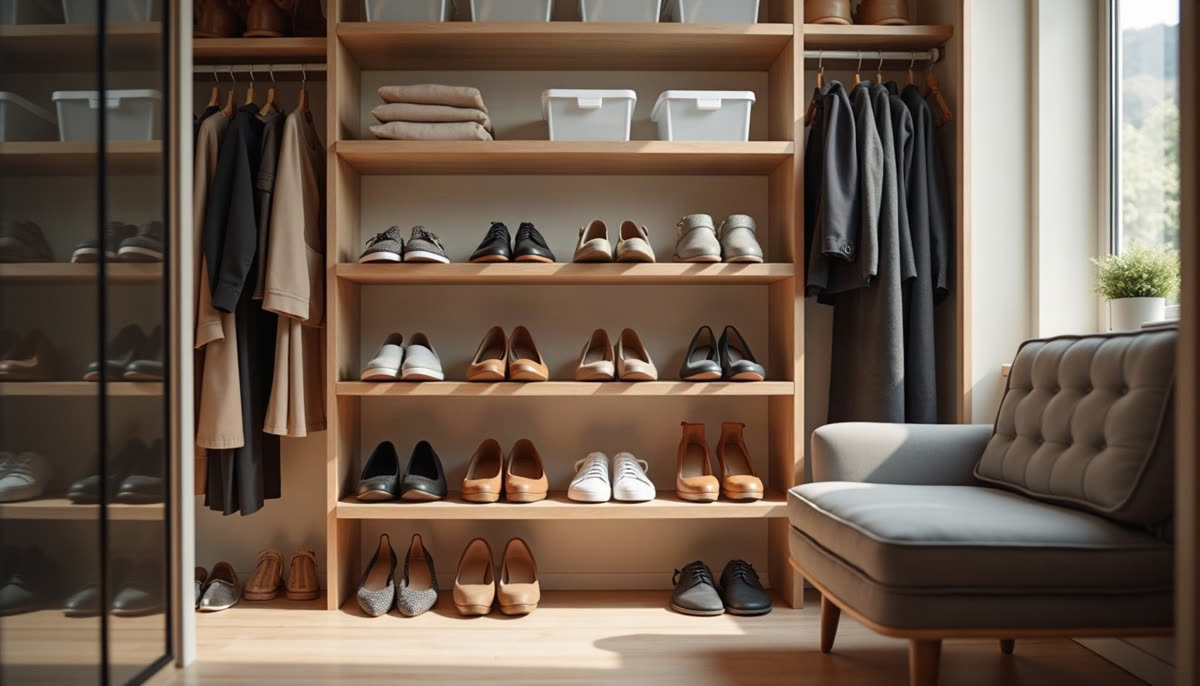
Angled or flat shoe shelves mounted on a closet wall keep every pair in view. They make sense if you are installing a closet system anyway, since most systems offer shoe shelves as an option. See how the main systems compare in our best closet systems guide. For where shoe shelves go in a bigger closet, see our walk-in closet storage ideas.
4. Hanging shoe shelves with no tools
Fabric organizers that hang from the closet rod come in shoe versions with small cubbies. They take up a slice of hanging space, so use one if you have more rod space than you need, or switch to slim hangers first to free some up.
Shoe storage for small closets
As an Amazon Associate I earn from qualifying purchases.
5. Clear bins on the top shelf for occasional shoes
The shelf above the rod is a good place for shoes you rarely wear. Clear or labeled bins show what is inside, so you do not have to pull everything down to look. Keep seasonal shoes up there and swap them twice a year. Check the clear height above the shelf first; our closet measuring guide shows how.
6. Boot shapers and boot racks for tall boots
Tall boots flop over and take up far more space lying down. Boot shapers keep them upright so you can line them up along the closet floor or under hanging clothes.
How to combine them in a small closet
- Door: over-the-door organizer for flats, sneakers and sandals.
- Floor: one or two stackable rack tiers for daily pairs, boots with shapers at the end.
- Top shelf: clear bins for formal and seasonal shoes.
- Rod: slim hangers to free up space, plus a hanging shoe shelf if you still need room.
For the rest of the closet, read small bedroom closet ideas that actually work and our picks for closet organizers under $100.
FAQ
How do I store shoes in a small closet without drilling?
An over-the-door organizer, a freestanding stackable rack, a hanging shoe shelf on the rod and bins on the top shelf all go in without tools.
Is it bad to store shoes in plastic bins?
Not if the shoes are clean and dry. Let them dry fully before you put them away, and choose bins with some ventilation if you live somewhere humid.
How many pairs can a small closet hold?
It depends on the closet and the shoes, but using the door, the floor and the top shelf together often holds far more than the floor alone. Start with the door, which is usually the biggest unused space.
Where should I keep heels?
Heels keep their shape better on shelves or a rack than in pockets. Keep them at eye level if you wear them often, or in a clear bin if you do not.
Finish the job
As an Amazon Associate I earn from qualifying purchases.
The bottom line
A small closet holds a lot more shoes once you stop relying on the floor alone. Hang an over-the-door organizer, keep daily pairs on a stackable rack, move occasional shoes to bins on the top shelf and stand boots upright with shapers. Most of this costs little, needs no tools and can be set up in an afternoon.
Product details and prices change. Always check the current listing before you buy.
Shop the look on Amazon