Disclosure: ClosetBlueprint is reader-supported. When you buy through links on our site, we may earn an affiliate commission at no extra cost to you. Learn more.
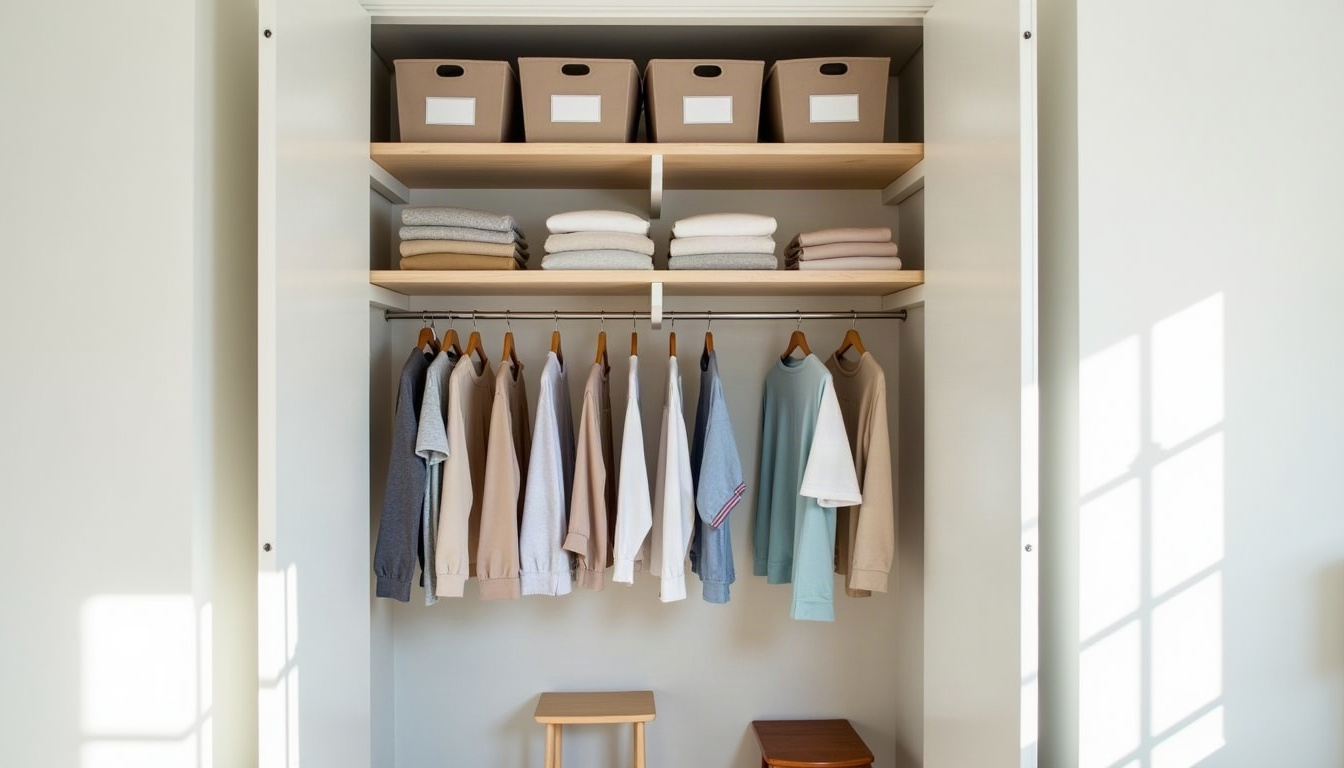
To organize a top closet shelf, put light, rarely used things up there in matching bins with a handle and a label facing you, so you can pull one down without looking inside. Use shelf dividers for anything you stack, like sweaters or towels. If there are 18 inches or more between the shelf and the ceiling, add a second shelf or a stackable riser to turn one tall, messy pile into two short, neat rows. Keep a folding step stool nearby, and never store anything heavy or breakable above head height.
The top shelf is usually the most wasted space in a closet. It’s too high to see into, so things get tossed up there and forgotten. The fix isn’t more stuff or fancier containers. It’s deciding what belongs up high, choosing containers you can grab blind, and using the full height between the shelf and the ceiling. Below is a simple system with measurements, plus ideas that work if you rent.
In this guide
What to store on the top shelf (and what not to)
Think of the top shelf as the place for things you use a few times a year. Anything you reach for every week should live between your shoulders and knees.
| Good for the top shelf | Keep it lower |
|---|---|
| Off-season clothes (sweaters in summer, swimwear in winter) | Clothes you wear every week |
| Spare bedding, extra pillows, guest blankets | Shoes you wear often |
| Bags and purses you rarely carry | Heavy boxes, books, file boxes |
| Keepsakes and memory boxes (light ones) | Glass, ceramics, anything breakable |
| Hats, scarves and gloves out of season | Tools, paint, cleaning products |
| Gift wrap, holiday clothes, costumes | Anything a child needs to reach |
A useful rule: if you couldn’t comfortably lift the box down with one hand while standing on a stool, it’s too heavy for the top shelf. Heavy things that fall from above head height are a real injury risk, and the stool makes it worse because you’re already off balance.
Measure first: how much space is up there?
In a typical reach-in closet, the main rod sits around 66 to 72 inches from the floor and the shelf sits about 2 inches above it, at roughly 68 to 74 inches. In closets with double hanging rods, the top shelf can be as high as 84 inches. (Our closet rod height guide has the standard numbers.) With an 8-foot ceiling, that leaves anywhere from about 12 to 28 inches of open space above the shelf. With a 9-foot ceiling, you might have 24 to 40 inches.
Measure three things before you buy anything:
- Height: shelf surface to ceiling (or to the door header, if the opening is lower than the ceiling).
- Depth: front edge of the shelf to the back wall. Most closet shelves are 12 to 16 inches deep.
- Usable width: wall to wall, then note how much of it you can actually reach through the door opening.
Then use this table to decide what to do with the height:
| Space above the shelf | Best setup |
|---|---|
| Under 12 in | One row of short bins (about 6 to 10 in tall), or folded stacks with dividers |
| 12 to 17 in | One row of standard bins (about 10 to 13 in tall) with a few inches of room to lift them out |
| 18 to 24 in | Add a second shelf or a stackable riser: two rows of short bins, or bins below and flat items above |
| Over 24 in | A full second shelf about 12 to 14 in above the first; the top level holds the least-used items |
Leave at least 2 to 3 inches between the top of a bin and whatever is above it. Without that gap you have to tilt the bin to get it out, and that’s when things spill.

Pick containers you can grab without looking
You can’t see into a bin that’s above your head, so the container has to tell you what’s inside and give you something to pull. That rules out most of what ends up on top shelves: open piles, shopping bags and cardboard boxes with the flaps tucked in.
Fabric bins with a front handle and a label
These are the workhorse. Look for bins with a handle or cut-out on the short end, so you can turn them with the handle facing out and slide them toward you. A label holder on the same end means the label is visible from the floor. Fabric bins with label holders are light, cheap and don’t crack if they fall. Measure your shelf depth first: a bin about 11 inches deep suits a 12-inch shelf, and a deeper one will hang over the edge.
Shelf dividers for stacks
If you’d rather keep sweaters or towels as folded stacks, clip-on closet shelf dividers keep each stack upright so it doesn’t slide into the next one when you pull something out. Keep stacks to about 10 to 12 inches high. Taller stacks lean and you’ll have to pull the whole thing down to reach the bottom item.
Baskets for odd shapes
Purses, hats and beach bags don’t stack. Put each group in an open basket with handles, which you can pull down in one move instead of fishing items off the shelf one by one.
Vacuum bags for bulky bedding and seasonal clothes
Vacuum storage bags shrink comforters and puffy jackets to a fraction of their size, which is a big deal on a shelf with only 12 inches of clearance. Put the compressed bag inside a bin so it doesn’t slide off. Many makers advise against keeping down and wool compressed for long periods, so for those, a breathable bin is often the better choice.
Clear boxes, with one caveat
Clear plastic boxes let you see what’s inside from the side, which helps on shelves at about eye level. Up high you’re mostly looking at the bottom, so a label still matters. Clear boxes are also heavier and can crack if dropped.
Add a second level when the gap is tall
A tall empty gap above the shelf is where top shelves turn into piles. Stuff gets stacked as high as it’ll go, and the thing you want is always at the bottom. Splitting the gap into two levels fixes that.
- Stackable shelf risers. Freestanding closet shelf risers sit on the existing shelf and create a second level with no tools. They’re the easiest option and work well for renters. Check the weight rating and the depth before buying.
- A second wall-mounted shelf. If you have 24 inches or more, a real shelf about 12 to 14 inches above the first one is sturdier and uses the full width. Standard shelf brackets screwed into studs do the job, and wire systems like ClosetMaid ShelfTrack let you add a shelf to the same track.
- A shelf above the door. In many reach-in closets, the wall above the door opening on the inside has a strip of unused space. A shallow shelf there is fine for very light things like hats or empty gift bags.
If your closet has wire shelves, lay a clear liner on top first. It stops bin feet and small items from tipping through the gaps.
Arrange the shelf from front to back
Even a well-labeled shelf gets messy if the layout fights you. A few rules keep it working:
- Most-used in the middle, in front of the door. The ends of a reach-in closet are behind the wall on either side of the opening, so put the least-used bins there.
- One row deep. Two rows of bins on a 16-inch shelf means the back row disappears. If the shelf is deeper than your bins, use the extra depth for one long flat item, like a folded rug, behind the row.
- Handles and labels out, all the same way. It looks tidier and you never have to turn a bin around to read it.
- Group by season or by person. “Winter, mine” and “Winter, kids” is easier to swap twice a year than bins by item type.
- Leave one empty slot. A gap gives you somewhere to put a bin while you dig through another one, and room for things that come in later.
Make it reachable
A top shelf only works if getting to it is easy. A slim folding step stool that hangs on a hook or slides into the gap beside the shoe rack means you’ll actually use it instead of standing on tiptoe. Look for one with a wide top step and a locking frame.
For the very highest level, store things you only touch once or twice a year, like holiday decor, so the stool trip is rare. And if a closet light doesn’t reach the shelf, a battery motion-sensor light stuck to the underside of the shelf above, or to the ceiling, makes labels readable.
Top shelf ideas for renters
You don’t need to drill to get more out of the space up high:
- Freestanding shelf risers instead of a second fixed shelf.
- Fabric bins instead of anything that needs to be mounted.
- Over-the-door hooks for bags you’d otherwise toss on the shelf.
- Removable adhesive label holders if your bins don’t have them.
- A tension rod across the top of the opening for lightweight items like scarves.
Everything on that list comes out when you move. For more no-drill ideas, see our small bedroom closet ideas.
What we'd use on a top shelf
As an Amazon Associate I earn from qualifying purchases.
A worked example
Take a 6-foot double-hang reach-in closet with an 8-foot ceiling, a top shelf at 84 inches that’s 14 inches deep, and a 48-inch door opening in the middle. That leaves 12 inches of height above the shelf.
- Twelve inches is too short for a second level, so it gets a single row of fabric bins about 10 inches tall and 13 inches deep, with 2 inches to lift them out.
- Six bins about 11 inches wide fit across the 72-inch width with a little room to spare. The four in front of the door hold off-season clothes, two per person. The two at the ends hold guest bedding in vacuum bags and holiday clothes.
- Each bin has a label and its handle facing out. A folding stool hangs on a hook inside the door.
Now take the same closet with a 9-foot ceiling. With 24 inches above the shelf, a riser or second shelf 12 inches up gives two rows of six short bins, twelve in total, and the top row holds the things you need once a year.
If you’re planning a whole closet rather than one shelf, our free closet design tool lays out rods, shelves and drawers from your measurements, and our list of closet organizers under $100 covers other inexpensive upgrades.
FAQ
How do you organize a high closet shelf you can’t reach?
Store only light, rarely used things there in bins with front handles and labels, so you can pull one down without seeing inside. Keep a folding step stool in the closet so getting up there takes seconds.
What should you put on the top shelf of a closet?
Off-season clothes, spare bedding, guest pillows, rarely used bags, light keepsakes and holiday items. Avoid heavy, breakable or everyday items.
How much space do you need to add a second shelf in a closet?
About 18 inches or more between the existing shelf and the ceiling. That allows two levels of roughly 9 inches each for short bins. With 24 inches or more, a second shelf 12 to 14 inches above the first fits standard bins on the lower level.
How deep should bins be for a closet shelf?
About 1 inch less than the shelf depth, so they don’t hang over the edge. On a 12-inch shelf, look for bins about 11 inches deep. On a 16-inch shelf, 14 to 15 inches works.
Are vacuum bags safe for the top shelf?
Yes, for bulky but light items like comforters and synthetic jackets. Place them inside a bin so they don’t slide, and check the maker’s advice before compressing down or wool for long periods.
The bottom line
Treat the top shelf as storage for things you use a few times a year, not a drop zone. Measure the height above the shelf, choose matching bins with handles and labels facing out, add a second level if you have 18 inches or more, and keep a stool within reach. Do that and the space up high stops being a pile and becomes the most useful shelf in the closet.
Shop the look on Amazon