Disclosure: ClosetBlueprint is reader-supported. When you buy through links on our site, we may earn an affiliate commission at no extra cost to you. Learn more.
A coat closet should be at least 24 inches deep, and 26 to 30 inches is better if your household wears puffy winter coats. Width depends on how many people use it: about 24 to 36 inches covers one or two people, and 48 inches or more suits a family of four in a cold climate. Put the rod at about 66 to 70 inches from the floor so long coats clear the floor or a boot tray, with a shelf 2 inches or so above it. None of this is building code. These are the working numbers designers and closet system makers use, so you can adjust them to your coats and your space.
Below you’ll find a dimension table, a rough way to work out how many coats fit on a foot of rod, what the door and the walls beside it do to usable space, and ideas for small coat closets that are already built.
In this guide
Coat closet dimensions at a glance
| Dimension | Minimum | Comfortable | Notes |
|---|---|---|---|
| Depth (back wall to door frame) | About 22 to 24 in | 26 to 30 in | Bulky down coats push past 24 in |
| Width, 1 to 2 people | About 24 in | 30 to 36 in | Guests’ coats need room too |
| Width, family of 3 to 5 | About 36 in | 48 to 72 in | Cold climates sit at the top of the range |
| Rod height | About 64 in | 66 to 70 in | Higher if you add a boot tray or have long coats |
| Rod distance from back wall | About 11 in | 12 to 14 in | Roughly half the closet depth |
| Shelf above rod | About 2 in above the rod | 2 to 3 in above | Room to lift a hanger hook off the rod |
| Shelf depth | 12 in | 12 to 16 in | Deeper shelves hide hats and gloves at the back |
| Door opening | 24 in | 30 to 36 in, or the full closet width | Usually 80 in tall in US homes |
Want to see how a rod, a shelf and a boot zone fit your wall? Our free closet design tool takes your width, height and depth and suggests a layout.
Coat closet depth: why 24 inches is the floor
An adult hanger is about 17 inches wide, the same figure we use in our reach-in closet dimensions guide. A coat is wider than the hanger it hangs on, because the shoulders and sleeves stick out past the ends. Add an inch or two of clearance at the back wall and the door, and you land at 24 inches for ordinary jackets and wool coats.
Puffy coats change the math. A thick down parka can add several inches of bulk around the shoulders, and the sleeves fold forward against the door. In a 24 inch closet, those coats tend to press against the door or hang at an angle. If you are building or remodeling in a cold climate, 26 to 30 inches gives them room. Beyond about 30 inches the extra depth mostly turns into space you have to reach past.
| Depth | How it works for coats |
|---|---|
| 20 to 22 in | Tight. Light jackets fit; coats brush the door. Slim hangers help a little, but the coat is still wider than the hanger. |
| 24 in | Standard. Wool coats, rain jackets and blazers hang freely. Two or three puffy coats will touch the door. |
| 26 to 30 in | Comfortable for down parkas, ski jackets and bags hung on hooks behind the coats. |
| Over 30 in | The front rod works, but the back corners become dead space. Consider hooks or a second, short rod on a side wall. |
Measure depth from the back wall to the inside of the door frame, not to the door itself. If you haven’t measured yet, our guide on how to measure a closet walks through every number in order.
How deep should a closet be in general?
For any closet where clothes hang across the width, 24 inches is the usual target and 22 inches is the practical minimum. Coat closets sit at the deeper end because coats are the bulkiest thing most people hang. Linen and pantry closets with shelves only can be shallower, often 12 to 18 inches, because nothing has to hang sideways.

Coat closet width: how much rod you need
Width is where the number of people in your home matters most. A rough planning rule is about 2 inches of rod per jacket, and more for heavy winter coats. Here’s how that plays out by coat type. These are estimates based on typical garment bulk at the shoulders, so measure a few of your own coats if you want a tighter number.
| Item on the hanger | Approximate rod space | Items per foot of rod (estimate) |
|---|---|---|
| Shirt (for comparison) | About 1 in | About 12 |
| Light jacket, rain shell, blazer | About 2 in | About 6 |
| Wool or tweed overcoat | About 3 in | About 4 |
| Down parka or ski jacket | About 4 to 6 in | About 2 to 3 |
Now apply it to a household. A family of four in a cold climate might have one parka, one lighter jacket and one rain shell each, which is four parkas at about 5 inches, four jackets at 2 inches and four shells at 2 inches. That comes to roughly 36 inches of rod before a single guest arrives. Add about a foot for visitors and you’re at 48 inches, which is why a 4 foot coat closet is a common choice for family homes. A couple in a mild climate with a few jackets each can get by with 24 to 30 inches.
A quick way to check your own: count every coat that should live in this closet, multiply by the inches in the table, add 12 inches for guests and compare it with your rod length. If the total is longer than the rod, move off-season coats to a bedroom closet or a vacuum storage bag until the weather turns.
Coat closet rod height
Set the rod at about 66 to 70 inches from the floor. Long winter coats on a hanger measure about 48 to 60 inches from the rod to the hem, so 66 inches leaves room under most of them. Our full closet rod height guide has a garment length chart if you want to check your longest coat.
Go to the higher end of the range when:
- You keep a boot tray on the floor. Boots with tall shafts stand 12 to 18 inches high. Coats should hang above them, not on top of them, so raise the rod a couple of inches or give boots their own end of the closet.
- Someone owns ankle-length coats. A coat that measures more than about 62 inches on the hanger needs a rod at 68 to 72 inches.
- The ceiling is 9 feet or higher. You have room for a taller shelf stack, so there’s no cost to a higher rod.
Go lower, about 54 to 60 inches, for a kids’ coat rod. Short jackets clear the floor easily at that height, and children can hang up their own coats. Some families add a short second rod below the adult rod on one side of the closet for exactly this reason. A rod doubler does the same job without any drilling.
Mount the rod about 12 inches from the back wall in a 24 inch closet, or at roughly half the depth in a deeper one. In a 28 inch closet that’s about 14 inches out. Heavy coats load a rod more than shirts do, so keep the span between supports on the short side, around 32 inches, if the rod will be full of winter wear.
The door and the returns
The door decides how much of the closet you can actually reach. Many hall coat closets have a single 24 to 30 inch door in front of a wider closet. The short wall sections on either side of the opening are called returns, and the space behind them is hard to use.
- Small returns (up to about 6 inches each): no real problem. Hangers slide behind them with a little effort.
- Large returns (12 inches or more): the ends of the rod become a parking lot for coats nobody wears. Put off-season coats or guests’ coats there, and keep everyday coats in front of the opening.
- Swing doors: the back of the door is free storage. Over-the-door hooks or a pocket organizer can hold bags, scarves and dog leashes. Check that the door still closes with things hanging on it.
- Bifold doors: they open almost the full width, so returns are smaller, but the folded panels stick into the hall and can’t hold hooks.
- Sliding doors: only half the closet is open at a time, and the track eats 2 to 3 inches of depth. In a 24 inch closet that can be the difference between coats fitting and coats rubbing.
If you’re building new, a door opening as wide as the closet, or close to it, is the easiest way to make a coat closet work. Our reach-in closet guide covers deep returns and side-wall rods in more detail.
Small coat closet ideas
Most people don’t get to choose their coat closet’s size. If yours is cramped, these ideas help without a remodel.
Use the back of the door
Over-the-door hooks hold the things that usually end up on the floor: backpacks, tote bags, umbrellas and dog leashes. A clear pocket organizer works for hats, gloves and sunglasses, and it means you can see what’s inside. Both hang without screws.
Give the top shelf a job
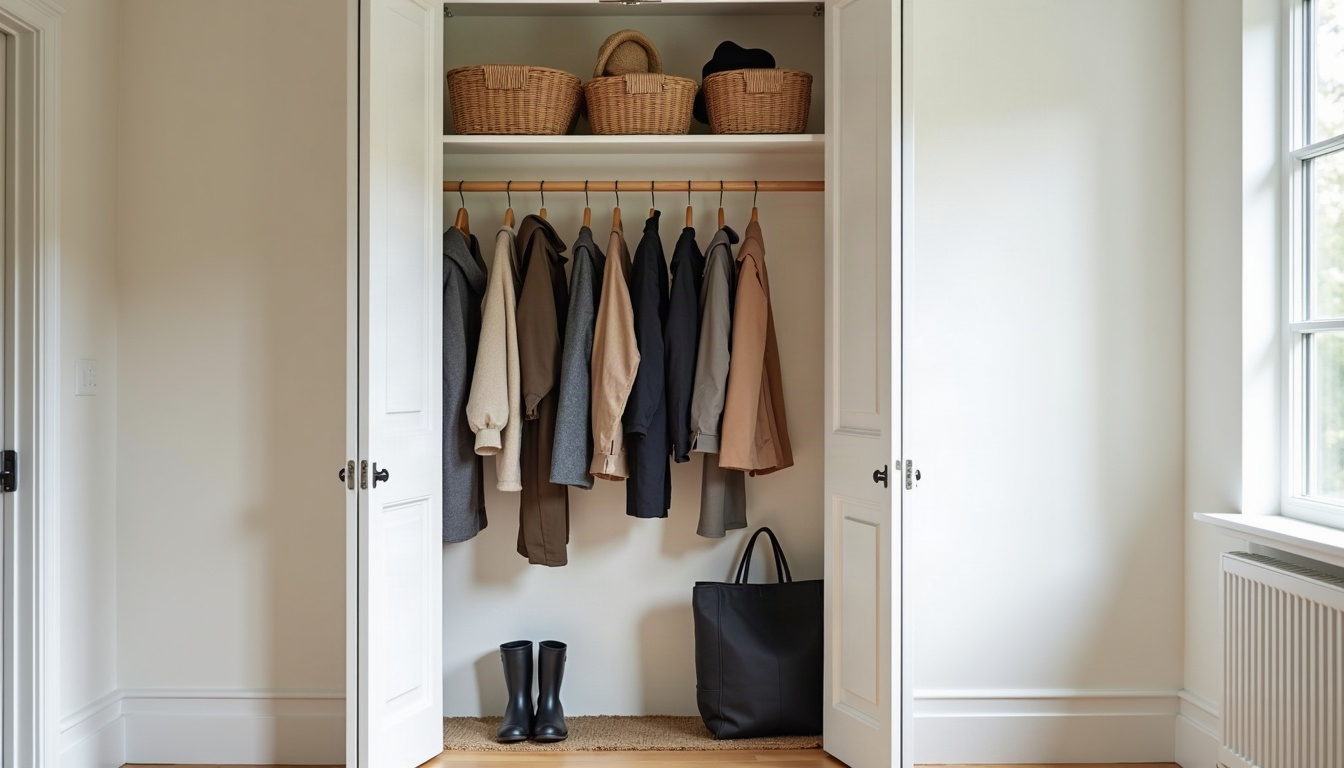
The shelf above the rod is often a jumble of hats and single gloves. Two or three lidless fabric bins or baskets, one per person or one per category, make it easy to pull a bin down, grab what you need and put it back. Label the fronts if more than one person uses the closet.
Add a boot tray
A rubber or plastic boot tray keeps snow and mud off the closet floor and gives shoes a defined place to go. Measure the floor depth first: many trays are about 15 inches deep, so they fit in front of or under the coats, but check the listing before you buy.
Match your hangers
Sturdy wooden hangers with wide shoulders hold heavy coats without sagging and keep their shape. A closet full of matching hangers also takes less rod than a mix of wire, plastic and dry-cleaner hangers, because nothing tangles. Skip thin velvet hangers for heavy coats; they can bend under a wet parka.
Rotate by season
The coat closet only has to hold what you wear this month. Put summer jackets away in winter and parkas away in summer. Of all the ideas here, rotating by season frees the most space, and it costs nothing.
Add wall hooks outside the closet
If the closet is very small, a row of sturdy hooks or a bench in the entry can take everyday coats and leave the closet for guests and off-season gear. Our small closet ideas have more space-saving tricks that work in any narrow closet.
Coat closet basics
As an Amazon Associate I earn from qualifying purchases.
A worked example
Say you have a hall coat closet that’s 48 inches wide and 24 inches deep, with a 30 inch swing door centered on the wall. That leaves returns of 9 inches on each side. Two adults and two kids live in a place with real winters.
- Rod: one rod across the full 48 inches at 68 inches high, about 12 inches from the back wall. Two adult parkas and two lighter jackets fill about 14 to 16 inches in front of the door. Guests’ coats and off-season jackets go behind the returns.
- Kids: a rod doubler hung from the right half of the main rod, with its lower bar at about 34 inches, so the kids can reach their own coats.
- Shelf: a 12 inch shelf at 70 inches with four bins, one per person, for hats and gloves.
- Floor: a boot tray under the left side, where the adult coats hang above the boot shafts.
- Door: over-the-door hooks for backpacks and the dog leash.
Run your own closet’s width, height and depth through our closet design tool to get a starting layout.
FAQ
What is the standard size of a coat closet?
Most hall coat closets in US homes are about 24 inches deep and 24 to 48 inches wide, with an 80 inch tall door. There’s no official standard, but those are the sizes builders use most often.
How deep should a coat closet be?
At least 24 inches. If you own bulky down coats or ski jackets, 26 to 30 inches lets them hang without pressing against the door.
Is 20 inches deep enough for a coat closet?
Only for light jackets. Coats are wider than the 17 inch hanger they hang on, so in a 20 inch closet they will touch the door or need to hang at an angle. Hooks on the back wall can be a better fit for a closet that shallow.
How high should a coat closet rod be?
About 66 to 70 inches from the floor, with a shelf a few inches above. Use the higher end for long coats or a boot tray underneath, and add a lower rod at about 54 to 60 inches for kids.
How wide should a coat closet be for a family of four?
About 48 inches works well in a cold climate. With roughly 2 inches of rod per light jacket and 4 to 6 inches per parka, four people’s everyday coats plus room for guests fills about 4 feet of rod.
The bottom line
Plan a coat closet around 24 inches of depth (more for puffy coats), a rod at 66 to 70 inches and enough width for every coat that has to live there, using about 2 inches of rod per jacket and up to 6 inches per parka. If your closet is already built, use the back of the door, the top shelf and the floor, and rotate coats by season. Before you buy a rod, shelves or a system, take your measurements and try them in our free closet design tool.
Shop the look on Amazon