Disclosure: ClosetBlueprint is reader-supported. When you buy through links on our site, we may earn an affiliate commission at no extra cost to you. Learn more.
You do not need a full closet system to fix a messy closet. Many of the most common problems, such as a crowded rod, toppling sweater stacks, shoes on the floor or a dark corner where things disappear, can be solved with a few inexpensive organizers. Most of the categories in this guide are sold well under $100, and many of them for a fraction of that.
This is a guide to product categories, not a ranking of individual products. For each one we explain what problem it solves, what to look for when you shop, and who it makes sense for. It is based on how these products are designed and how people commonly use them, not on hands-on testing or sponsored placements. Prices change constantly, so always check the current listing before you buy.

Quick comparison
| Organizer | Problem it solves | Installation | Renter-friendly | Budget level |
|---|---|---|---|---|
| Slim velvet hangers | Crowded rod, clothes slipping off | None | Yes | $ |
| Rod doubler | Wasted space under short-hang clothes | Hooks over existing rod | Yes | $ |
| Shelf dividers | Folded stacks that topple | Clip onto shelf | Yes | $ |
| Fabric bins | Small items and clutter on shelves | None | Yes | $ |
| Hanging shelves | No shelves in the closet | Hangs from rod | Yes | $ |
| Over-the-door organizer | Shoes and accessories with no home | Hooks over door | Yes | $ |
| Drawer organizers | Messy drawers (socks, underwear, belts) | None | Yes | $ |
| Motion-sensor lights | Dark closet, can’t see what you own | Adhesive or magnetic | Usually | $ |
| Shoe racks | Shoes piled on the floor | Freestanding | Yes | $–$$ |
| Rolling drawer carts / stackable drawers | No dresser space | Freestanding | Yes | $–$$ |
Budget level is relative within this guide: $ is the low end, $$ is closer to the top of the under-$100 range.
1. Slim velvet hangers
What it solves: mismatched wire, plastic and wooden hangers take up a lot of rod space. Slim, flocked (velvet-covered) hangers are much thinner, and the fuzzy surface keeps silky tops and wide necklines from sliding off.
What to look for:
- A swivel hook, so every hanger can face the same way.
- Notches or a tie bar if you hang straps, camisoles or pants.
- A sturdy build if you plan to hang heavy coats. Very thin hangers can bend under winter coats, so keep a few heavier hangers for outerwear.
Who it is for: almost everyone. Switching to one hanger style is often the cheapest single change that makes a closet look organized. They are typically sold in multi-packs of 30, 50 or 100.
Keep in mind: the velvet grip makes it a little harder to slide clothes on and off quickly, and some people notice light fuzz on dark fabrics.
2. Closet rod doublers
What it solves: a single rod with short-hang clothes beneath it leaves the bottom half of the closet empty. A rod doubler hooks over your existing rod and hangs a second rod below it, which can nearly double your hanging capacity for shirts, skirts and folded pants.
What to look for:
- Adjustable drop length so you can set the lower rod height.
- Adjustable width to match the section of rod you want to double.
- A stated weight limit, and hooks that sit securely on your rod’s diameter.
Who it is for: renters and anyone with a reach-in closet full of short-hang clothes. If you want a permanent version, a closet system with a fixed double-hang section does the same job. Our guide on how to measure your closet lists typical rod heights for double hanging.
3. Shelf dividers
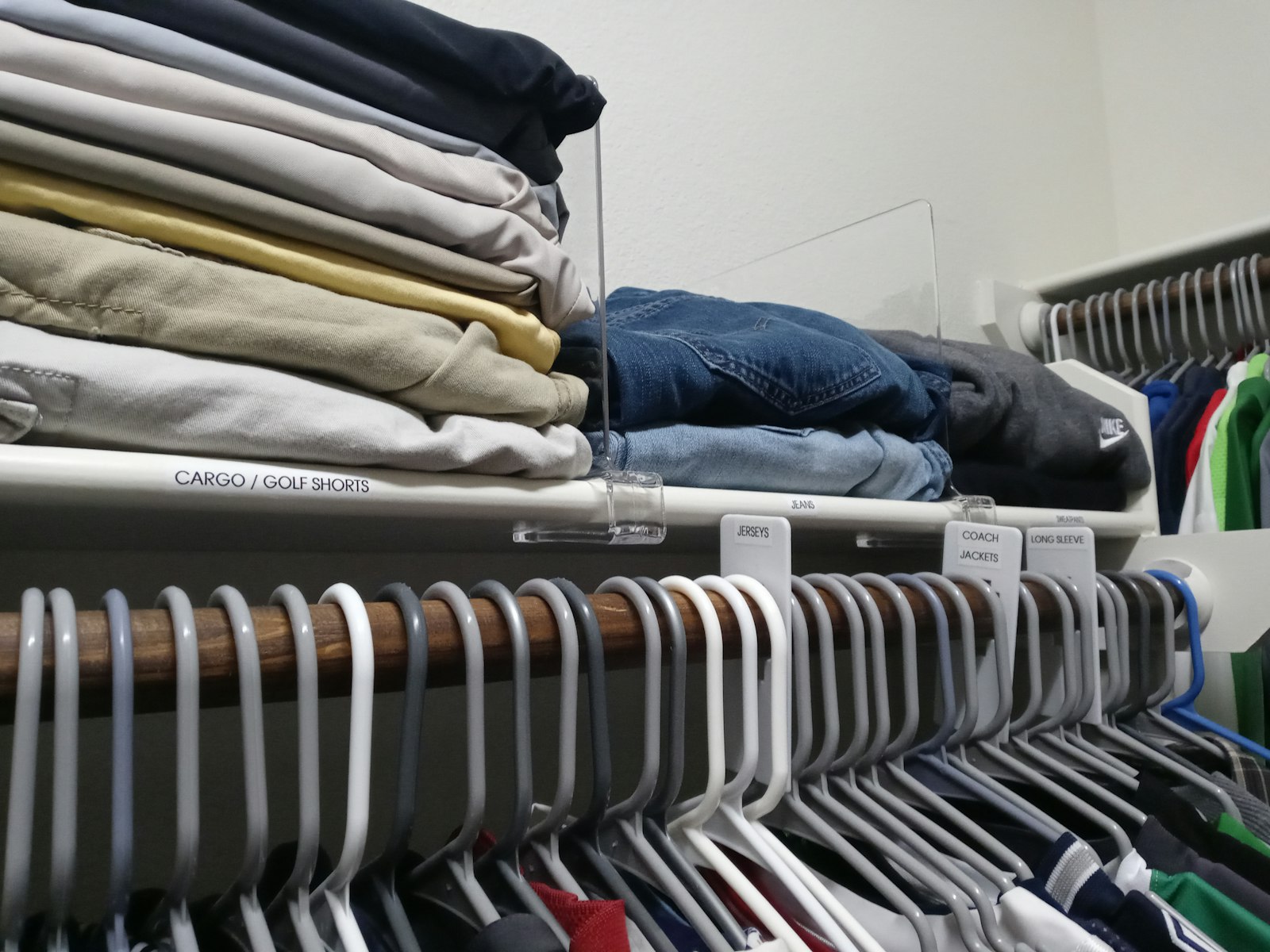
What it solves: stacks of sweaters, jeans and towels lean, merge and fall over. Shelf dividers slide or clip onto the shelf to create upright walls between stacks.
What to look for:
- Fit for your shelf thickness. Many clip-on dividers are designed for a specific thickness range, so measure your shelf first.
- Clear acrylic dividers look tidy and blend in; metal wire dividers are often sturdier.
- For wire shelving, look for dividers made specifically for wire shelves.
Who it is for: anyone who stores folded clothes on shelves, especially on a long top shelf.
4. Fabric storage bins
What it solves: loose items such as scarves, hats, swimsuits, gym clothes and out-of-season accessories turn shelves into a jumble. Bins give each category a container you can pull down and put back in one motion.
What to look for:
- Measure your shelf depth and the clear height above it before buying. Bins that are too deep hang over the edge; bins that are too tall will not fit.
- Handles or pull loops, especially for high shelves.
- A label holder or window, so you know what is inside without opening it.
- Structured sides that do not collapse when half full.
Who it is for: everyone, and especially families. Bins with picture labels are one of the easiest ways to help kids put things away (see our kids’ closet ideas).
5. Hanging closet shelves
What it solves: many older or rental closets have only a rod and one high shelf. A hanging shelf organizer attaches to the rod with hooks or straps and adds a vertical column of cubbies for folded clothes, bags or shoes.
What to look for:
- Internal stiffeners or rigid shelves so the cubbies do not sag.
- Secure attachment to the rod (hook-and-loop straps or metal hooks).
- A cubby depth that matches what you plan to store.
Who it is for: renters, dorms and anyone who needs shelving without drilling. If you outgrow it, a real shelf tower is the next step; see our roundup of the best closet systems.
6. Over-the-door organizers
What it solves: the back of the closet door is usually wasted. Over-the-door organizers turn it into storage for shoes, accessories, belts, scarves or even cleaning supplies.
What to look for:
- Clear pockets if you want to see what is inside at a glance.
- Hooks that fit your door thickness without stopping the door from closing.
- Pocket size that fits your shoes. Pockets on many shoe organizers are sized for flats and sneakers, not boots or very large shoes.
Who it is for: small reach-in closets with hinged doors. For sliding or bifold doors, a slim wall-mounted rack on a side wall is a better fit. More ideas in our small bedroom closet guide.
7. Drawer organizers
What it solves: socks, underwear, ties, belts and jewelry get mixed together in a drawer. Divider inserts or small boxes give each item its own section.
What to look for: measure the inside of your drawers (width, depth and height) first. Adjustable spring-loaded dividers and modular boxes in several sizes are the most flexible. Fabric “honeycomb” organizers work well for socks and underwear.
Who it is for: anyone with a dresser or closet drawers. A small purchase, but it often makes a daily difference.
8. Motion-sensor closet lights
What it solves: many closets have no light, or one dim bulb on the ceiling. Battery-powered or rechargeable LED lights with a motion sensor turn on when you open the door and switch off by themselves.
What to look for:
- Rechargeable (often USB) versus disposable batteries.
- Light bars or strips for under shelves and above rods, and puck lights for corners.
- Magnetic or adhesive mounting, so you can move them without tools.
- A warm or neutral light color if you want colors to look natural.
Who it is for: any closet without good lighting. Being able to see what you own is a big part of actually wearing it.
9. Shoe racks
What it solves: shoes piled on the closet floor get scuffed and lost. A rack lifts them up and lines them up.
What to look for:
- Stackable or expandable racks for odd-width closets.
- Tier height that works for your shoes; boots need taller spacing.
- Slanted shelves show shoes better; flat shelves hold more styles securely.
- Tall, narrow towers should be stable and, if very tall, secured to the wall.
Who it is for: anyone whose shoes live on the floor, and especially households with several pairs per person.
10. Stackable drawers and rolling carts
What it solves: not enough dresser space, or a closet with no drawers at all. Plastic or fabric drawer units fit under short-hang clothes or on the closet floor.
What to look for: drawers that slide smoothly, a footprint that fits under your lowest rod, and clear or labeled fronts. Rolling carts are handy if you need to pull them out to reach things behind.
Who it is for: renters, kids’ rooms and small bedrooms where a dresser does not fit.
How to choose: start with the problem, not the product
1. Edit first
Organizers cannot fix a closet that is simply too full. Pull everything out and remove what you no longer wear before buying anything.
2. Measure before you buy
Rod length, shelf depth, the clear height between shelves, and door thickness decide which organizers will actually fit. Our measuring guide walks you through it.
3. Spend where the problem is
If your rod is overflowing, slim hangers and a rod doubler will do more than any bin. If your floor is buried in shoes, start with a rack. If you can’t see anything, start with a light.
4. Know when to upgrade
If you find yourself stacking several organizers to make up for a closet with no shelves, no drawers and one rod, a DIY closet system may be the better value. Compare materials in our wire vs. laminate vs. wood guide and typical budgets in our closet cost guide.
FAQ
What is the single best closet organizer to buy first?
For most closets, matching slim hangers. They free up rod space right away and make everything else easier to organize. If your closet is mostly short-hang clothes, add a rod doubler next.
Are cheap closet organizers worth it?
Often, yes, as long as they fit your space and you check weight limits. Inexpensive organizers are especially sensible for rentals, kids’ rooms and closets you plan to redo later.
What closet organizers work without drilling?
Hangers, rod doublers, hanging shelves, over-the-door organizers, bins, drawer organizers, freestanding shoe racks and most adhesive or magnetic lights all install without tools.
Do velvet hangers really save space?
They are much slimmer than typical plastic or wooden hangers, so the same rod can usually hold more garments. How much you gain depends on what you are replacing.
🛒 Shop the essentials on Amazon
- Slim velvet hangers
- Closet rod doublers
- Closet shelf dividers
- Fabric storage bins
- Hanging closet shelves
- Over-the-door shoe organizers
- Drawer organizers
- Motion-sensor closet lights
- Stackable shoe racks
As an Amazon Associate I earn from qualifying purchases.
The bottom line
Under $100 can go a long way in a closet if you buy for the actual problem. Start with matching slim hangers, add a rod doubler or hanging shelves for capacity, use dividers and bins to keep shelves tidy, and put the door and floor to work with an over-the-door organizer and a shoe rack. A motion-sensor light is a small extra that makes everything easier to find. When small fixes stop being enough, look at a full closet system.
Prices and product details change. Always check the current listing before you buy.